
Development of artist and movements that have influenced me. 1/12/20 updated 4/01/21
Early German Expressionists
These artists sought to create their own voice through combining elements of classical German art with tribal and Impressionism and Fauvist colour theory.
I am very drawn to the ‘modernist ‘ styles that they favoured and can identify with the passion and fervency that they introduced into their work. (Tate 2020) .They were keen to produce realistic images that suggested an accessible narrative for their audience. Struggling to find my own voice, I have been helped by their example . I do not need to produce images that family or friends may expect as the ‘recognised ‘ face of art. It has been difficult to break away from this traditional belief but this group’s paintings have been one of the influences on me to use unusual colour choices and textured rather than photorealistic work.
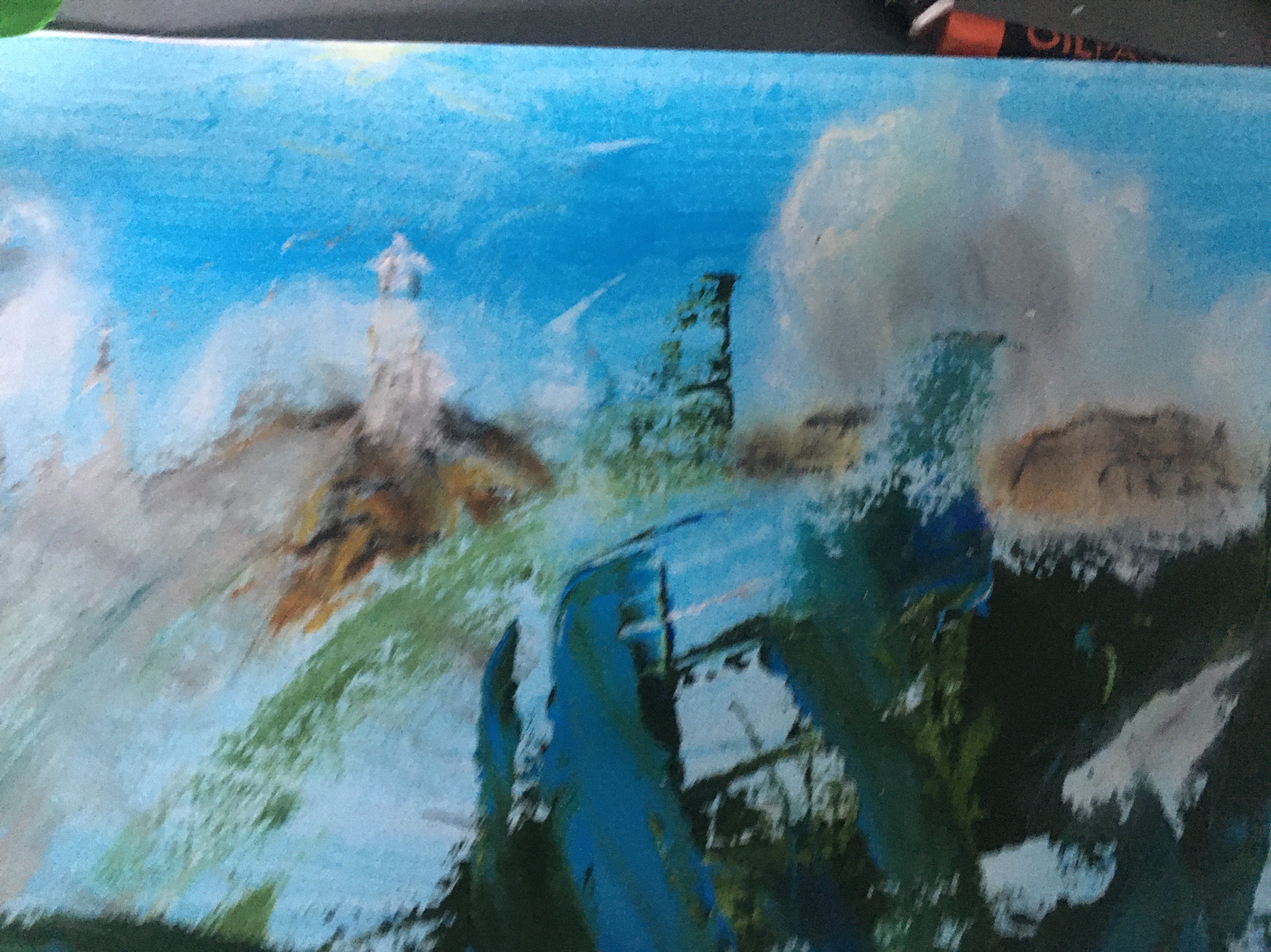
These are two works that I made between Parts 4 and 5 . My colour pallet contains areas of colour contrast ( image two) influenced by the fauvist aspect to German Expressionism
Ernst Ludwig Kirchner, one of the founders of the Brucker ( bridge) movement (seen as the birth of German Expressionism ), particularly triggers connections in my imagination. He left the group early on but helped to construct their initial criteria and inspiration from. munch and Van Gough works(Reder , 2016) . I love the freedom suggested in his work at this time. It puts a modern slant on old classics eg
Czardas Dancers (1908). This could be a Classical Greek vase depiction with dancers frozen mid movement . However the bold reds and green costumes contemporary to the date of painting and the heavier fluid marks making means that it becomes understandable and real to the audience of his time. The fluid movements suggest energy and passion . I do not understand the timeframe or culture of Ancient Greece but I cannot help but engage with Kirchner’s exciting depiction.
Later he moved to Berlin. In the 1910’s it was a typical European preoccupied by commercialism and class but also one enveloped in unease and resentment which would eventually lead to war. 1914 ‘s The Street and Postdamer Platz are works from his most remembered period. The narrative of The street ( masked prostitutes dressed in finery symbolising the notion at that time that everything could be bought) and the fluid elongated figures painted on angular streets attract me through their quirkiness. Underneath though there is another message . In contrast to the bold colours and energetic figures, the jarring angles of his shapes create unease in the viewer. ( Goddard, 2003) This is intensified in Postdamer Platz by the man stepping out into the road, his left leg advancing into the foreground like the jagged edge of a knife. On reflection, I suppose at an amateurish level, I sit at this stage. Full of energy and determined to tell my story in a new way. I like simple shapes that collide and create discourse in my pictures. I suspect that for me ( unlike Kirchner) this could be because I have not yet developed the skills to bring drama without the visual shock factor. I hope that I can develop my drama through texture and greater understanding of paint media.


Recent figure work. I have kept to a simple pallet tried and to incorporate tones and complimentary colouring . There is much less colour drama, dark panda eye shading and sharpness around my facial features as I have tried to show depth through impasto and scraping.
Recent Sea scapes using layering and multimedia to give texture and perspective. I am relying less on dramatic shaped rocks and strange angles. The picture itself is less complex.

After the profound effects that the Great War had on him Kirchner moved to Switzerland and as Goddard observers, with time he began to pull back from his clashing geometric shapes and figures became perhaps more as expected. He continued to use jarring perspectives but in a subtle more sophisticated way in interiors like the woodwork depicted at impossible angles in ‘Mountain Studio’ 1937 retaining elements of surreal but the composition fitted together in some sort of acceptance. The narrative remains and is joined by little jokes around his life suggesting the confidence that experience brings. I believe that the energy now comes from his choice of pallet. Goddard quotes from one of his late letters to a friend:
‘“Here one learns how to see further and go deeper than in ‘modern’ life, which is generally so very much more superficial despite its wealth of outer forms.”’
After tutor feedback, I have returned to my research into his life and find myself more and more intrigued by and in awe of his personal and artistic resilience . All along he moved in his own way to follow where his style took him. Throughout he studied his environment closely and found ways to vocalise his passion and emotion for his subjects. I live in hope that practice , emotional vision and the courage to change will inform my development over my lifetime of painting.
Tate: 2020 . Bricked: Brücke was a German expressionist group founded in Dresden in 1905 which developed a radical anti-traditional style characterised by vivid non-naturalistic colour and emotional tension.At https://www.tate.org.uk/art/art-terms/b/brucke .(First Accessed 1/12/20 and updated to 4/01/21)
Reder, H(2016) Ernst Ludwig Kirchner German, 1880–1938At https://www.moma.org/artists/3115 ( accessed last on 4/01/2021)
Goddard.D (2003) Ernst Ludwig Kirchner:1880-1938 At.https://www.newyorkartworld.com/reviews/kirchner.html ( accessed 04/01/21)

