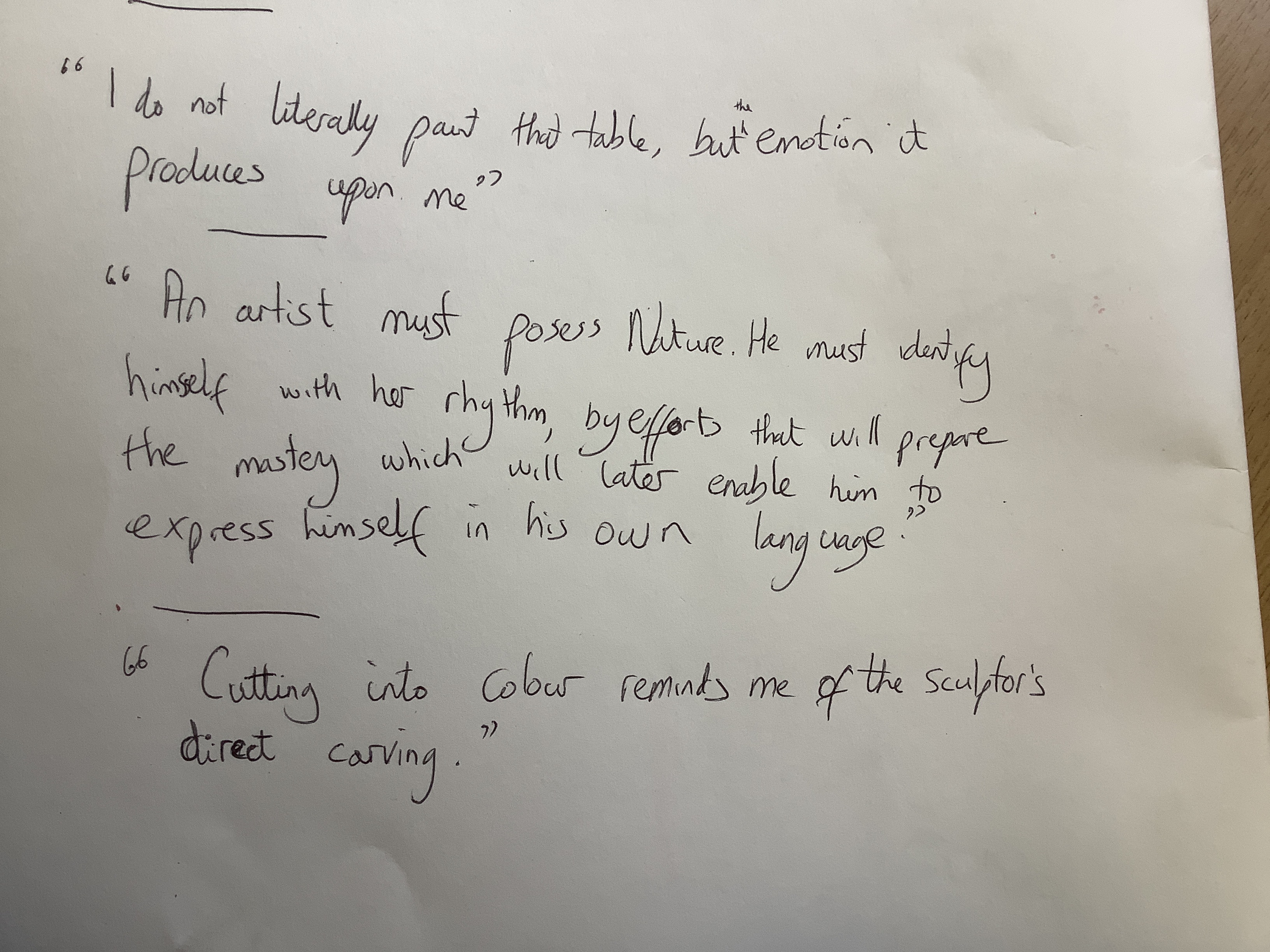
Development of artist and movements that have influenced me. 1/12/20 updated 4/01/21
Early German Expressionists
These artists sought to create their own voice through combining elements of classical German art with tribal and Impressionism and Fauvist colour theory.
I am very drawn to the ‘modernist ‘ styles that they favoured and can identify with the passion and fervency that they introduced into their work. (Tate 2020) .They were keen to produce realistic images that suggested an accessible narrative for their audience. Struggling to find my own voice, I have been helped by their example . I do not need to produce images that family or friends may expect as the ‘recognised ‘ face of art. It has been difficult to break away from this traditional belief but this group’s paintings have been one of the influences on me to use unusual colour choices and textured rather than photorealistic work.
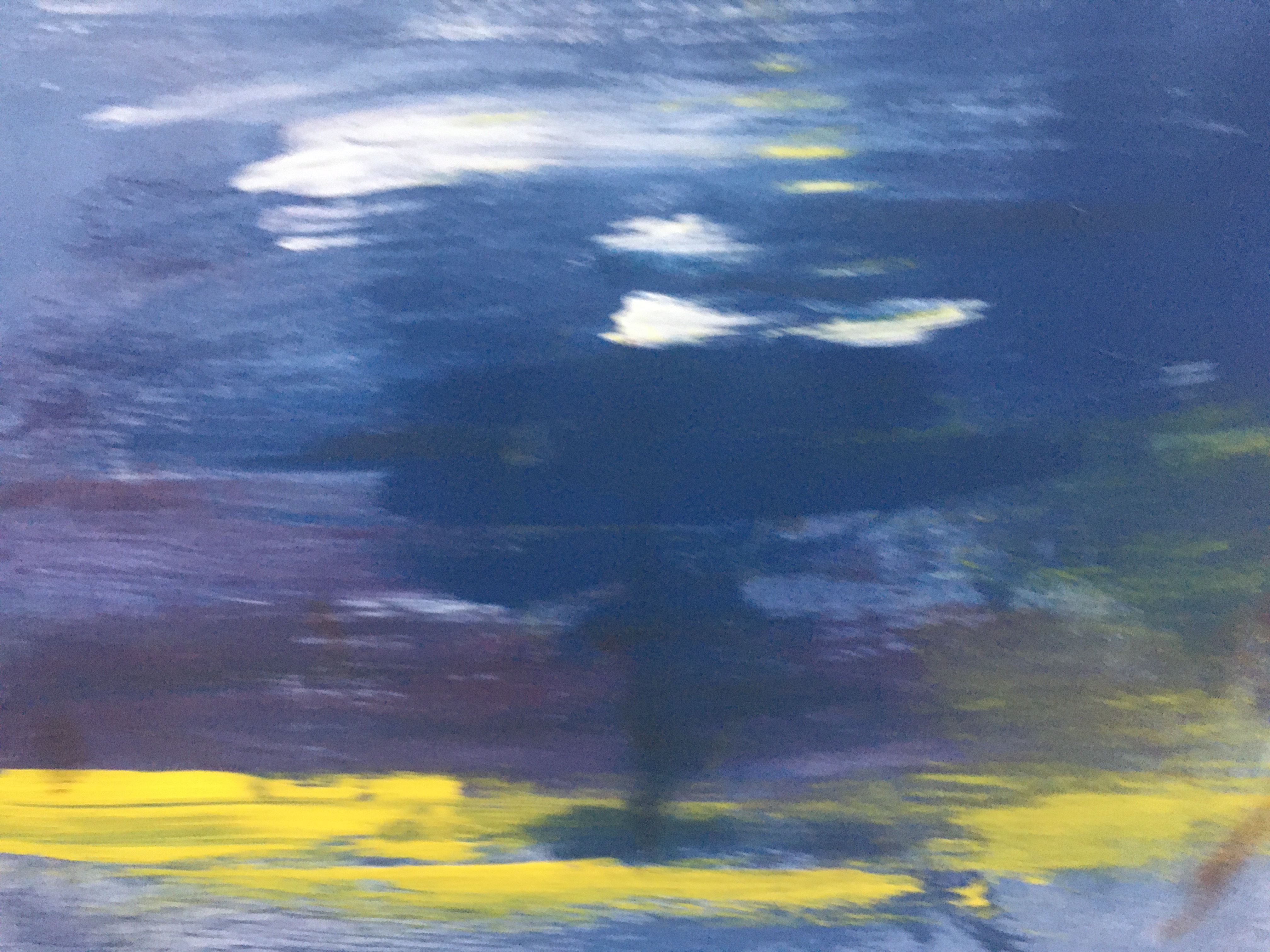
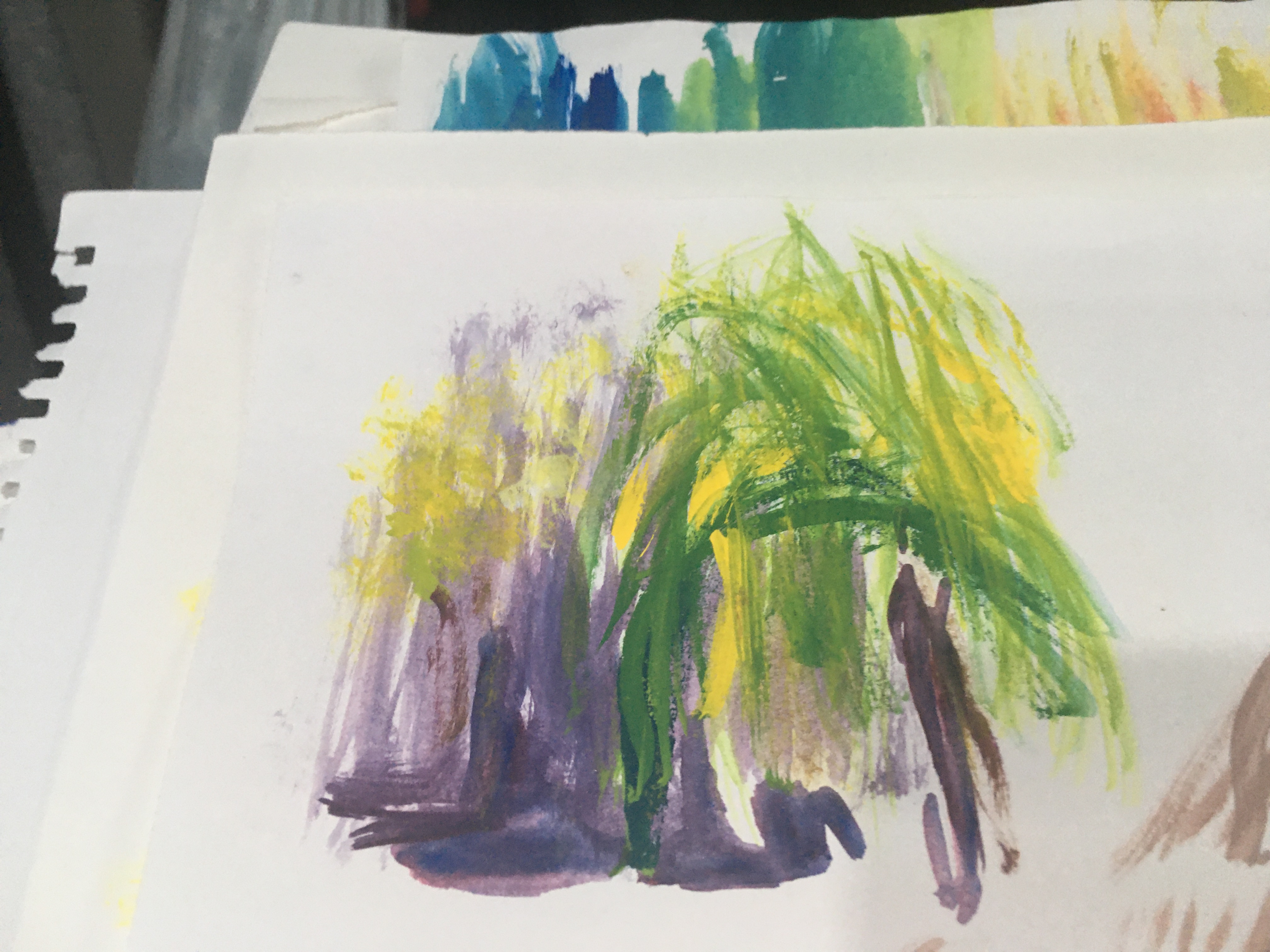
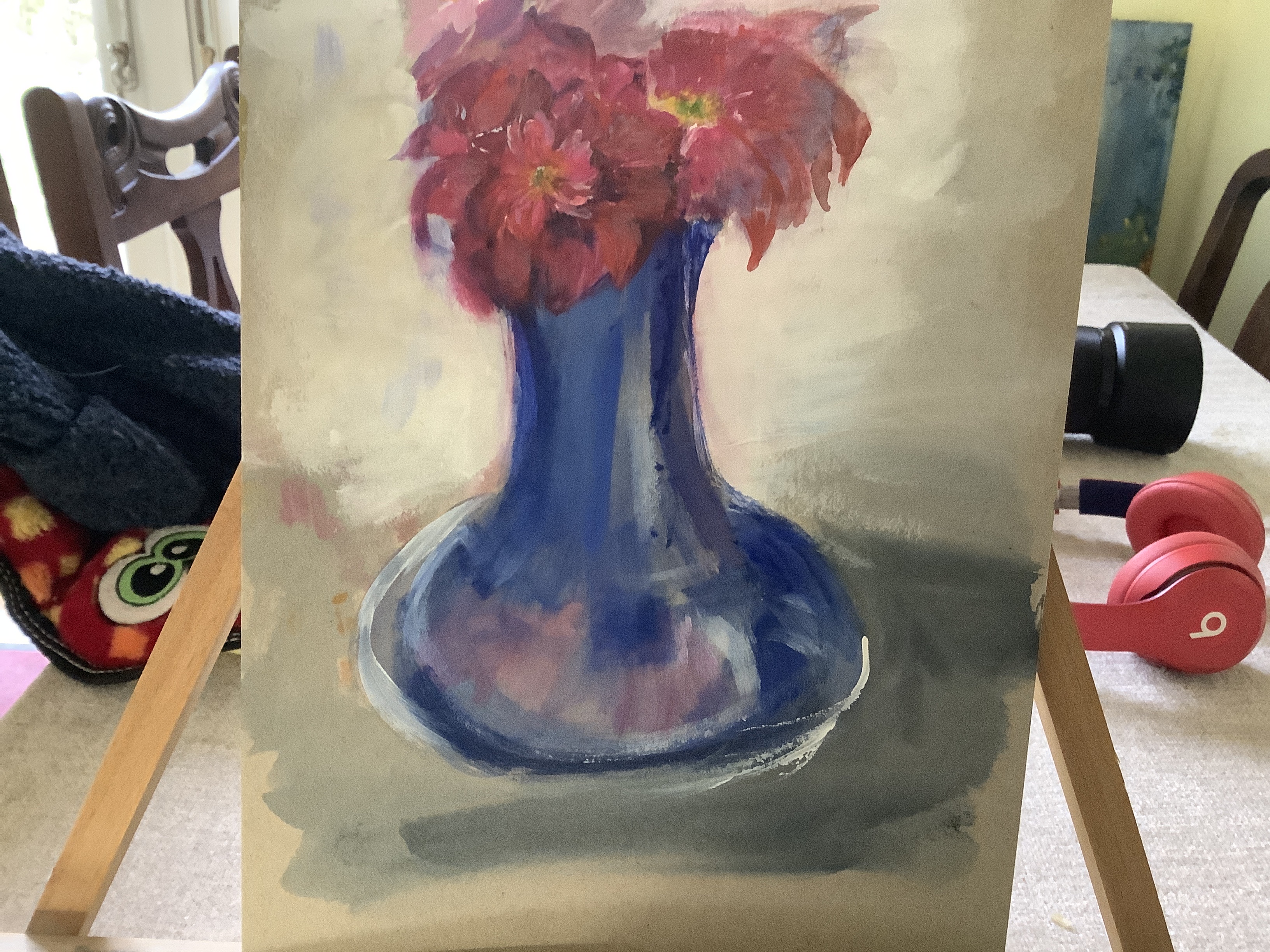
These are two works that I made between Parts 4 and 5 . My colour pallet contains areas of colour contrast ( image two) influenced by the fauvist aspect to German Expressionism
Ernst Ludwig Kirchner, one of the founders of the Brucker ( bridge) movement (seen as the birth of German Expressionism ), particularly triggers connections in my imagination. He left the group early on but helped to construct their initial criteria and inspiration from. munch and Van Gough works(Reder , 2016) . I love the freedom suggested in his work at this time. It puts a modern slant on old classics eg Czardas Dancers (1908). This could be a Classical Greek vase depiction with dancers frozen mid movement . However the bold reds and green costumes contemporary to the date of painting and the heavier fluid marks making means that it becomes understandable and real to the audience of his time. The fluid movements suggest energy and passion . I do not understand the timeframe or culture of Ancient Greece but I cannot help but engage with Kirchner’s exciting depiction.
Later he moved to Berlin. In the 1910’s it was a typical European preoccupied by commercialism and class but also one enveloped in unease and resentment which would eventually lead to war. 1914 ‘s The Street and Postdamer Platz are works from his most remembered period. The narrative of The street ( masked prostitutes dressed in finery symbolising the notion at that time that everything could be bought) and the fluid elongated figures painted on angular streets attract me through their quirkiness. Underneath though there is another message . In contrast to the bold colours and energetic figures, the jarring angles of his shapes create unease in the viewer. ( Goddard, 2003) This is intensified in Postdamer Platz by the man stepping out into the road, his left leg advancing into the foreground like the jagged edge of a knife. On reflection, I suppose at an amateurish level, I sit at this stage. Full of energy and determined to tell my story in a new way. I like simple shapes that collide and create discourse in my pictures. I suspect that for me ( unlike Kirchner) this could be because I have not yet developed the skills to bring drama without the visual shock factor. I hope that I can develop my drama through texture and greater understanding of paint media.
Updated work (4/01/21) to show angular effects in my work- the waves take on a leaf like effect suggesting trying to push through a jungle.Updated example (04/01/21) I am trying to use mixed media paint effects to bring drama to my wave rather than the angular effect that can still be seen in the spikes at the top right. The swirling is too heavy a mix and jumps out from the rest of the work but it is a step on my journey to develop more drama with less shock factor.
Recent figure work. I have kept to a simple pallet tried and to incorporate tones and complimentary colouring . There is much less colour drama, dark panda eye shading and sharpness around my facial features as I have tried to show depth through impasto and scraping.
Recent Sea scapes using layering and multimedia to give texture and perspective. I am relying less on dramatic shaped rocks and strange angles. The picture itself is less complex.
After the profound effects that the Great War had on him Kirchner moved to Switzerland and as Goddard observers, with time he began to pull back from his clashing geometric shapes and figures became perhaps more as expected. He continued to use jarring perspectives but in a subtle more sophisticated way in interiors like the woodwork depicted at impossible angles in ‘Mountain Studio’ 1937 retaining elements of surreal but the composition fitted together in some sort of acceptance. The narrative remains and is joined by little jokes around his life suggesting the confidence that experience brings. I believe that the energy now comes from his choice of pallet. Goddard quotes from one of his late letters to a friend:
‘“Here one learns how to see further and go deeper than in ‘modern’ life, which is generally so very much more superficial despite its wealth of outer forms.”’
After tutor feedback, I have returned to my research into his life and find myself more and more intrigued by and in awe of his personal and artistic resilience . All along he moved in his own way to follow where his style took him. Throughout he studied his environment closely and found ways to vocalise his passion and emotion for his subjects. I live in hope that practice , emotional vision and the courage to change will inform my development over my lifetime of painting.
Tate: 2020 . Bricked: Brücke was a German expressionist group founded in Dresden in 1905 which developed a radical anti-traditional style characterised by vivid non-naturalistic colour and emotional tension.At https://www.tate.org.uk/art/art-terms/b/brucke .(First Accessed 1/12/20 and updated to 4/01/21)
Listing of the development aims and criteria that I will follow in this assignment.
Repetitive engagement with learning objectives has been integral to my development during Unit 3 . As I have has lists of general and personal objectives it has been challenging to keep all fresh in my mind. Therefore I feel that it is right to list them and record my responses to each.
A. General aims and objectives
Assignment instructions P 97
show how skills in handling paint have developed
[the skills that I currently want to demonstrate development in are: applying more layers of paint to increase detail and perspective; using a variety of brush marks and tools to suggest texture and movement and using inspiration from suitable artists. I have enjoyed researching recommended artists ‘s work more than ever this time, possibly because the more that I am immersed in the painting process the more I can begin to appreciate about individual style and technique and also how the social history and knowledge of the time informed artistic creation. Freud in his portraits used a lot of impasto texture which seemed to record his rapid brush work permanently on the canvas, adding a sense of urgency and intensity. I like this technique and wish record the speed and excitement which I feel when painting. As I am working in acrylics I feel that I can best do this by applying fast loose strokes in a variety of ways. For this painting I have been practising with different sizes of brushes and using both wet and dry brushes. I have noticed that the manner of application and the unique characteristics of each type of paint can be exploited to produce different effects.I also want to use thinner paint application to allow more tones and detail by working in many layers.]
–
show development in interpreting the subject
[Earlier in the unit I observed families on a beach and drew a selection of family groups. I learned to observe the quickly,watching each how each gesture or change in posture affected the whole body and the dynamics and positioning of the rest of the family. I reused a selection of these sketches to work out the best pose for my model and how to notice the effect her grin had on all of her body.]
Consider and explain lighting, sitter consideration, medium selected and landscape positioning of my paper instead of the more conventional portrait.
[I have begun to notice how artists use aesthetic as well as technical skills. For example; interior, background and colour can be used interpret the subject by suggesting emotions such as warmth in Van Gough’s sunflowers or the melancholy of Picasso’s blue period. My tutor has recommended the work of E Kirchner as an artist who uses colour and sweeping shapes to give a particular look to his subjects. I particularly like his simplified moody dark backgrounds which pop with what appears often to be distorted suggestions of pavements and buildings in complimentary bright hues. I admire his figure work which is sweeping and elongated giving an unsettling allure to the street girls in his Berlin 1910-13 series. His paintings appear simplistic but are hugely illustrative . I tried ,with partial success, to employ his thinking to a background in the ‘ telling a story’ exercise in unit 3 to suggest the close bond of a family grouping. However for my assignment piece I drew back a little as I didn’t have the confidence to go completely into blocks of colour background and elongated shapes. I did feel able though to attempt his uncomplicated colourful palette. One more artist whose paintings I used as comparisons throughout the unit was the contemporary oil artist Clare Shenstone . Her version of simplified backgrounds are monochrome spaces that are given depth by tonal variation which seems to both anchor and hilight the subject on the canvas. Initially I hoped to work more towards this style in my work. I intended to show dark water stretching out to the suggestion of branches on a far off river bank .] make preliminary studiesshow how skills in interpreting the subject have developed
[
I decided on an outdoor theme knowing that I am more able to work with this than interior scenes. Observations of my model were made around noon on a dullish day so the light direction was straight downward on to the face and meaning shadows would fall up and down rather than to one side. The choice of media was one of practicality rather than taste. I have been away from home so acrylic was better for it’s shorter layer drying time. The portrait would be a close-up face looking back over a shoulder from a river background , so I felt that a landscape format was best for spacing. My idea was that the close up & eye -level line could be used to make the viewer feel that they are in the boat behind the model. Also I reasoned that it would allow me to show a story narrative of and movement through wind blowing in the hair and background trees.
Demonstrate practice handling of paint and choice of skin tones-
[I spent
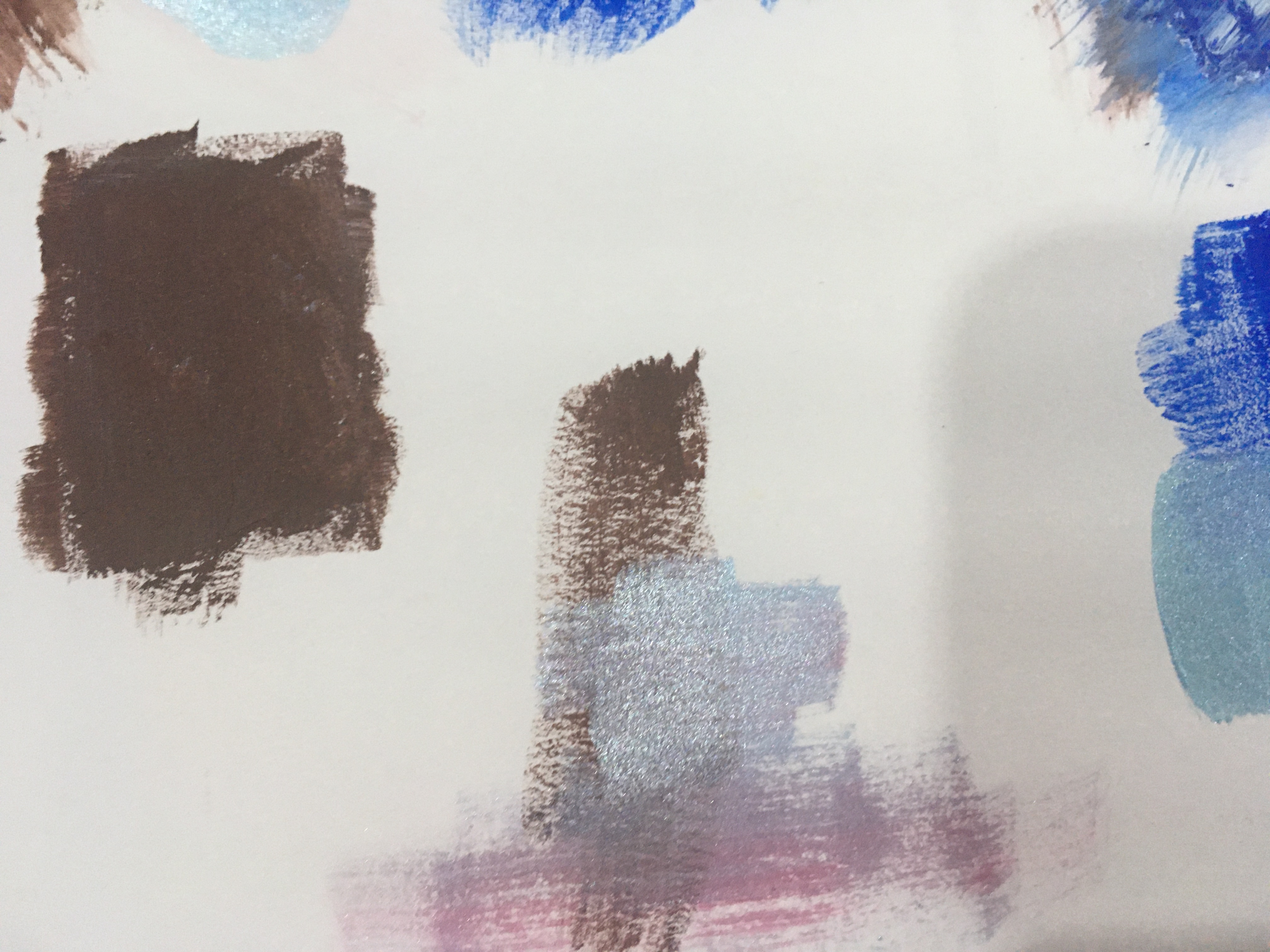
quite some time practising paint application, transparency of paint layers and mark making to understand what would suit my purposes best. The acrylic paint brands that I had were of different textures so I used these sessions to find what spread best and flowed well off the brush. I got a better coverage and flow using Artiste brand liquid acrylic brand while my abstract brand 200ml sachets that I had previously favoured were thicker, more buttery and therefore more difficult to use on a brush without dilution. I was surprised that although cheap and not intended for studio use, my liquid brand gave intense even coverage and flowed well without diluting intensity.]
I learned during these practices to slow down my painting speed a little and make a better attempt to cover an area evenly. This enhanced the intensity and smoothness of the surface. I had one pearlescent blue which gave a depth and shine to the sea.
Module assessment criteria : 
Unit aims and objectives
⁃ to use drawing and painting for investigation, generating ideas and recording and selecting visual information ⁃ to make skilful use of a range of media ⁃ to demonstrate knowledge and understanding of the work of some important artists and movements in painting ⁃ to reflect perceptively upon personal learning experience
B. Personal aims and objectives
Tutor feedback outcomes that I have tried to carry through my learning in this unit : –markmaking to suggest form -colour giving dramatic effect -take time to observe shape and tone ⁃ using curves to tell a story ⁃ using different tools ⁃ observing perspective in a way that I can show it
–layering ⁃ textures to accentuate feel ⁃ study artist’s work ⁃ Use rawness and fluidity in my style
See coursework three

Materials used: Liquid acrylic: red hot and cool hue; primary yellow; iridescent blue. Soft acrylic abstract dark brown; white and blue. Thinning medium for acrylics. Large flat brush; medium filbert and round brushes;a medium fishtail brush; pencil and rubber pointed pastel blending tool.
Multimedia A3 paper 200g
Preliminary studies   These are some of the sketches that I made while people watching on a beach for my ‘telling a story exercise’. I found this extremely beneficial in training me to observe the body posture of each pose my model made in terms of how it attested the whole body. For example when told to smile a child often tilts the head back and tenses up the whole body to appear taller as well as stretching wide mouth musculature! I was able to look at my model with greater awareness of how she held her head looking back over her shoulder and how her eye brow , mouth and even the angle of her shoulders and crown changed as she widened her grin. Over time working out correct anatomy for each part of the body has become more like imagined -sculpture , by this I mean that I think about how muscles and skin must flow and connect to each joint in the body rather than just copying a mark as if isolated in space. From a group of different positional drawings I decided on the background and how the face should fit in to it- ie to the right third rather than in the middle to invite the viewer to look into the painting. I also wanted a simple colour block of background with a few clearer tree branch marks made using different brushes and strokes.  I experimented on scrap paper to select best leaf marks that were not too distinct and distracting from the subject.   The initial pencil sketch is not a flattering drawing of the model but allowed me to loosely explore the curves that flowed across her face eg the natural line expanding across her face curving round the nose, mouth and cheeks and creating her broad grin of enjoyment. Movement was to be suggested by the curling strands of hair flying out behind her and by tree branches.
Next I tried several outline drawings in yellow to check positioning of the person,explore the connection between marks across the page and to indicate negative spaces and shade. One of the yellow outlines was far too close to the right hand edge . I also found it useful to use a mini post-it to mark things that I liked or wanted to avoid as a reminder to myself.     I also spent a lot of time painting colour blocks to learn how the two types of acrylic acted on the paper. The fluid colours are for me much easier to use when making loose marks. The soft abstract brand are less mailable and therefore I wanted to use them more for texture. They also didn’t mix well with thinning medium. I also worked out which colours would give translucent layering.
  
Next I worked on skin tones to find the best balance of tones that worked well to give depth. Then I checked this by painting a practice face. 
Stages of painting and Influence of artists
One of the main skills that I have taken onboard is about looking deeper at subjects. What are the stand out features of this person I am . Looking at portraiture I have begun to observe the importance of this. rying to depict? It is not just simply trying to get eyes right or the shape of the nose.
In order to bring a narrative to a portrait physical features are important.Looking at my model and a photo of her canoeing, the thing that really stood out was her cheeky smile. Trying to capture this would add realism to the likeness and would suggest enjoyment. Kirchner was able to stretch the proportions of his figures making the a little grotesque and surreal. As an inexperienced artist I am finding that this is not something that I get away with as my skills are not developed enough. For this reason once again my practice head looks a little cartoonish as I have enlarged the eyes and accentuated the curves of the cheeks and eye brow. I known from earlier exercises that this is a tendency that I repeat and to minimise this I must keep standing back and take time to observe what has happened with each layer. Have I used too heavy a line, does in need to be faded or broken up? Is the tone to different, do I need to mix a closer match? I found a useful tool for this. A flat plastic food tray allowed me to place my mixes over the top of my work to see exactly how the new tone will look.
One of the technical aspects that I am not good at is linear perspective. While I will benefit from practicing this, I have also had a discussion with my tutor about trying to pick up on other perspective techniques that I am currently better at to achieve the best that I currently can. The human smile is created by the entire muscle as it tightens across the face and cheeks and therefore correctly positioning the tonal shadows cast by stretched muscles would help to show perspective round the mouthfeels my model. I also practiced mark making for the sea using the soft creamy thickness of the darkernear blue, the blended turquoise pearlescent of the shallows of waves and the dotted thicker application of white foam ( using a pastel blender and cloth) contributed to give definition.
This tonal practice was trial and error. As I gain more experience I hope to use this skill in planning. Eg as I learn what is translucent and produces a good effect on top of another layer I can use this to my benefit rather than losing effects and having to redo layering !
Maintaining significant features: As the layers advanced I had to keep the curved lines visible but not too emphatic. As I discovered in my previous exercises, the suggestion of a line or form or the painting in of negative space works better than creating a bold unbroken mark. Eg on the cheeks , nose and eyebrows. I notices the features that were most striking about my model were her beautiful wide grin and the cheeky looking line of her raised eyebrows. I spent a lot of time lightening and darkening and trying to break up some of the solid lines by adding tonal difference.  I also used the thicker quality of the white paint to create textural ridges that I could build up tonal wrinkles near her eyes. I feel that this helped to give definition and show that the head was turned slightly so that the side of the head was seen as a darker tone. I also tried to give less definition to the ears to help with proportion.
Dry brush strokes: I also overpainted broken dry hair marks on the side of the head to help with proportion.
The background: As I worked in the different layers I found that I was moving away from my original plan. The formal banks and green abstract of trees seemed to be drawing attention away from the subject. The green was out-of -step with the other blending tones and caused disharmony. Therefore I decided to cover it over with a layer of blue to tone it down. Michael Raederich and Peter Doig were recommenced artists in my feed back from assessment 1. So I decided at this stage in my painting to go back and research their work to find some influences that would help me to add markmaking in further layers that connected the work up and improved the narrative. I reread my thoughts on Doig and how his colour choice and markmaking in the background awakened in me an intriguedand sometimes uneasy feeling . I wanted my work to create drama and movement to add to the riversailing narrative. Looking further I found this account of Doig talking about a fellow artist, Sigman Polke who had influenced him. He felt that Polke did not produce photographic images but took pleasure in markmaking that he had ‘discovered ‘ in his practice. This is inspiring and opens up a whole new line of thought for me. Further Doig talked about how Polke had developed a way to make his painted markmaking into a language and even though he broke normal rules of positioning and form he did it in a way that ended up looking authentic . I have read in the past that when we let our drawn ideas emerge without concentrating on what we want to produce, the result can be surprising but beautiful ( reference for this quote is unknown). Perhaps by relaxing I could learn to adapt this more into my work in the future? The background that emerged is still rather stiff because it was a first experiment and I was not sure about following my idea to start. However for me it represents the future of a new technique in painting for me to produce a more connected wholistic piece.
This gradually evolved into a different story for the painting. I enjoyed the depth of the darkening sky and found myself getting connected to a new narrative: a dusk river trip. I was reminded of Michael Raederich’s dark blue/grey atmospheric work which pops due to the embroidered white, yellow and pink abstract forms. I added yellow in various layers to look like the start of a sunset. While the positioning of the yellow in the darkening sky was not naturally accurate it felt more pleasing than the harshness of the river scene. I have learned to have more courage to go with changes in my work and am glad that I did so here. Eventually I wanted to pull things together and added some red as pink and a suggestion of purple in the sky. This abstraction evolved and I have to admit that my inexperience allowed me to play too far. I wonder if a bit of restraint ( as exercised by Raederich) would have produced a simpler and more effective message? This was a good learning and excites me for further experiments in the future.
Lastly I turned to the question connecting up the parts of my painting. Without the river bank where was my model? I gradually evolved a new narrative by adding in a horizon and tonal alteration to show where the sea and sky met. However this would have been more effective if there had been more room to develop it’s change slowly. Next I felt that as the paddle board that I decided she was on could not be seen clearly I could add a small silluette to give authenticity to her positioning in relation to the sea and sky. Finally I thought that instead of a white tee shirt it would be better to make this darker to suggest depth as the rest of the painting was also fairly dark. I added final fine shading around the eye and a little very dry red brush to some area to pull it all together tonally
Analysis of what has worked and what I want to improve
In most portraits that I have worked on background has been an afterthought for me and I always feels that it sits uneasily with the figure. While I need to have more courage to take the background further into my imagination it feels like a technique that could improve the spontaneity and flow of my painting in future. As I described the background evolved and possibly I could have made the whole painting bigger or decreased the size of the subject to allow the proper space to develop the change from sky to sea, to show the waves in proportion and to make the silluette more realistic. However I do feel that my process is evolving.
I feel that as I described in my comments agains the assignment aims, I started out with ideas to demonstrate my deepening understanding of technical skill, context and creativity. I am especially pleased that took time and discipline to make many more layers with a much larger variety of tones and to observe and correct as much as I could at each stage. Looking at the final image, I can see that in order to ensure that the raised brow stayed as the predominant feature, I lost some of the looseness. However I am confident that I am more confident to explore and find ways to develop my range of techniques.
Finished image
After writing up this assignment, I thought again about one of my personal learning aims: to use a variety of mark making. i have made three further alterations:
I used the spine of a feather to add fine detail to the eyes and to make smaller hair details. Then I used the long flat side of the spine to make a dragged hair mark to add contrast and bring the darker hair out in front of the wave. I also worked on the waves to add a blue green before the white surf ( the green was added using scrunched cling film for texture and the white was blended in and stippled using the end of a flat brush. I also took some of the darkened area out of the eyebrow to make the gesture more subtle ( as I observed in my analysis) .it occurred to me that I could blend in skin colour again stippling with the end of a flat brush. I feel that these additions improve my painting.
Tutor led formative feedback is the fuel to fire my next work, inspiring and filling me with energy. I have taken notes from my feedback discussion to construct a mind-map . I find this process consolidates learning. In addition it will act as a summary checklist for future projects.
My last comment in assessment 2 was a realisation that part way through projects I run out of energy and self -belief. This is a challenge that I have carried with me from Drawing 1. Consequently demotivation causes me to abandon my experiments and slide backwards into my comfort zone for the rest of the exercises and assessment work. The mind -map will focus my attention on key processes from PoP Learning Objective 1 while I am also attempting to learn new skills and research artist work in coming exercises. The map addresses aspects of perspective, texture and mark-making, composition and colour which then feed out to other tools to achieve these aims. I notice too that many of the skills feed back in to affect each other. I intend to look back at these regularly throughout each painting and project to keep me on track of development aims in a more considered and continuous way.
For example to achieve LO1 aims check- that my perspective works ( by observing the subject closely/ looking at lines in relation to each other/ by breaking structure into simple shapes) – this feeds into two points (1) a reminder to check back at results and build up layers giving definition and correcting mistakes and (2) picking the type of perspective that I find easiest to use effectively.
Again working quickly with raw fluidity will help me to observe effects that appear in my work – leading to checking that I use fluidity as a recognised strength as the painting progresses to new layers – then leading to checking that I use another passion of mine , curves that are built through attention to negative spaces. This pathway will remind me to keep loose and fluid using a range to techniques. Of course the dotted lines indicate that fluidity leads me back into checks and tips for mark-making. The whole process is inter- related.
Close ups of my mind-map
In the centre- concentrate on basic structure, shapes and tone
Mark making can be suggestive- it does not need to be refined into a polished image. Therefore it allows the mind to form its own story based on personal circumstances and preferences
Colour can suggest mood eg hot and cold , dark and light and red and green hues.
Use a viewfinder to find the most appropriate view. Noisier what is important and crop the rest.
Pay attention to definition of images. Have the discipline to slow down and use appropriate tools to make this right eg a rule for horizon and credit card for straight blades of grass- don’t be lazy and paint free-hand
Observe perspective carefully and pay attention to lines in relation to each other. Break structures into simple shapes to make this easier.
Take the time to work in layers and build these over time. This helps keep texture and thickness of paint right and enables perspective to be achieved through shade and tone and to correct image structure
Study other artist’s work so that their good and bad habits begin to subconsciously affect choices in painting
Maximise use of the type of perspective which works best for me – for now this is non- linear
Observe textures to accentuate perspective and create an illusion of touch for the viewer. Experiment with this including using non- traditional tools to encourage loose marks
Some examples from past work to start me off:
Notice the rawness which I naturally put into my work and have the courage to use this to creat fluidity and development in a piece
Use my tendency to work quickly as a strength- to suggest movement and energy in my work
Use negative painting to accentuate the curves and flow that I love to put into my work
Evening at the stone circleColour from my check list- gives the dramatic contrast that I want between the coming cold night and the fire of the sunset still spreading over the ground. The orange /red is almost complimentary to the blue . This combination is striking and draws the attention of the viewer. It suggests a dramatic and slightly mysterious mood.
Following the dotted lines would show that dramatic mark-making links into this point and suggests drama.
However I do feel that if I had looked to the other points on my check list I could have worked further on this piece. For example , while I used mark – making and fluidity of stroke for the standing stones, I ignored this in the sky and lost the chance to make it more expressive and energetic. Looking further round at perspective, I have not tried to break the sky into small segments or compare lines in relation to each other and I have not used non- linear effects like graduated tonal values in the blue. I am glad that I have begun this process and recognise that it will not happen overnight. However if reminding myself of these perspective techniques as I go through the painting reminds me to think about the possibilities open to me, I may eventually hold the techniques in my head and apply them to work automatically.
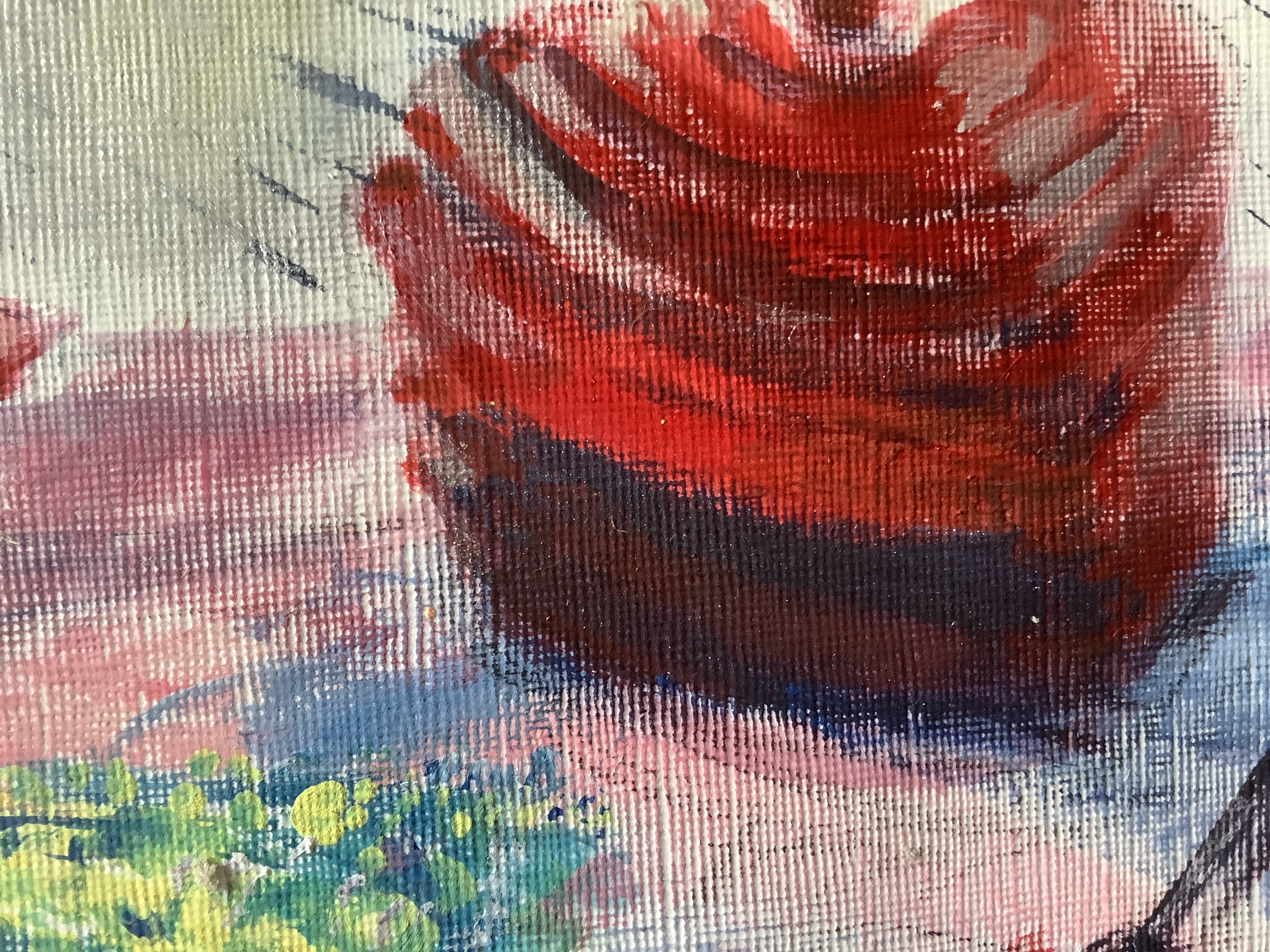
Texture and colour to suggest perspective. However to improve this I could use a variety of tones of blueI used pouring medium with undiluted liquid acrylic to increase the fluidity and texture of my stone. I like the way that this produces shine when areas of concentrated pouring medium hit the light. The rough mixing on the support gives a nice diffused watercolour like effect where binding of colours is incomplete. A close up reveals that I used too many unblended tones and short strokes: learning point- observe, experiment then observe the results before attempting a painting then use fewer large sweeping strokes. Come back later to add more tones with a finer brush as required – next observe and build on more layers. This also need to work on the thickness of my paint to get the correct mixture.I can see that looking at lines in relation to each other and making better use of tonal values in colour could have improved the perspective in this painting.The image has been cropped from its original (showing the window, wall and a calendar) to concentrate on the best part of the painting which I feel is the curves and fluid marks on the tray. I used negative space between the red petals on the tray to accentuate this. It is one of the perspective tips from my mind map.I have again used non- linear colour perspective to suggest a third dimension.
I find still life challenging and recognise that I need to find a simple scene allowing me to demonstrate growing understanding of use of perspective and colour theory.
Aims for inclusion:
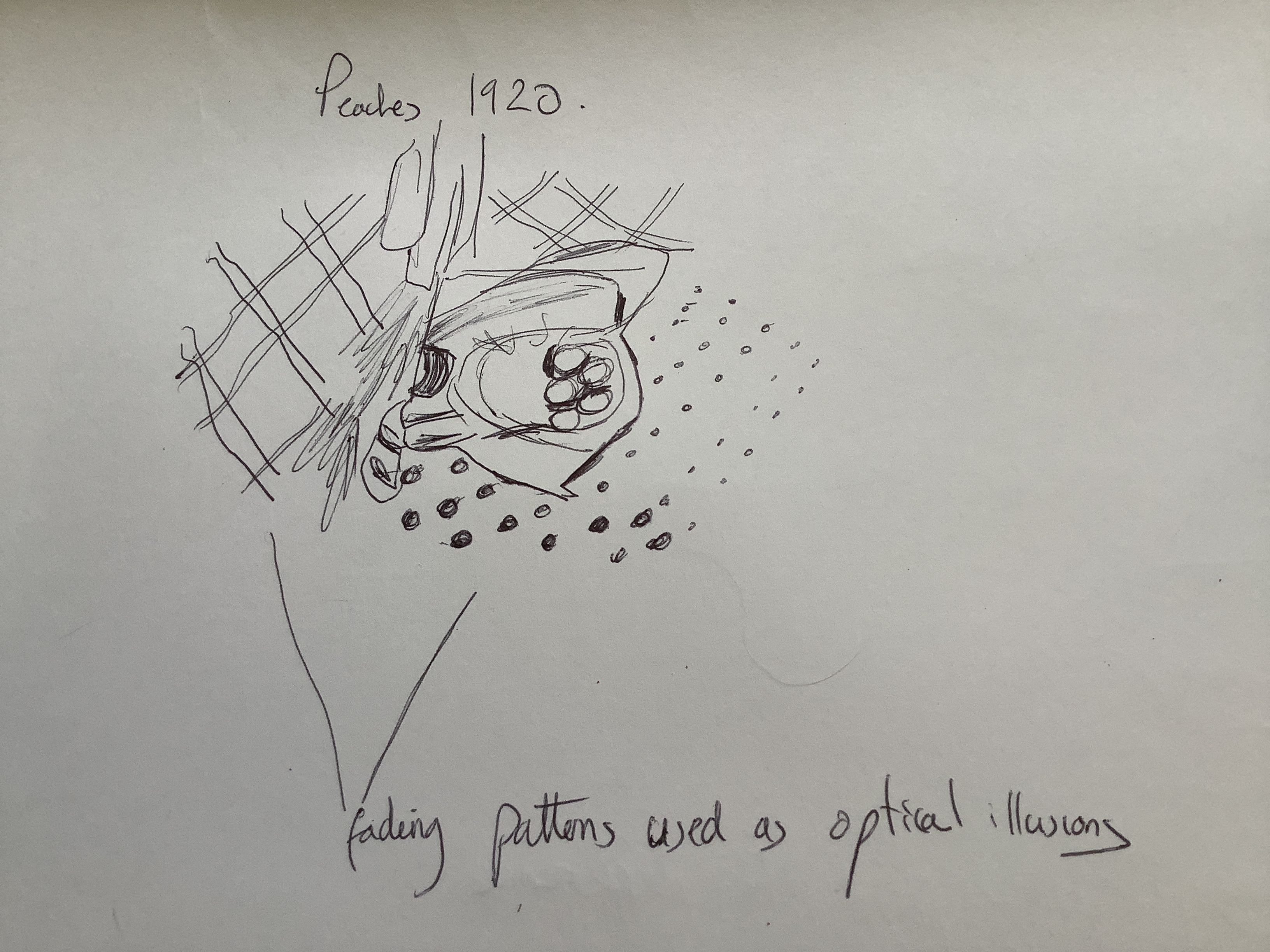
I am drawn to use sweeping and curved objects in my work. This can be used to show aspects of optical mixing – eg the black and white optical illusion in a diamond grid top of my patio table.
I enjoy using blocks of colour with tones and shades to suggest depth.
I love how artists like Gwen John use tonal light to suggest perspective.
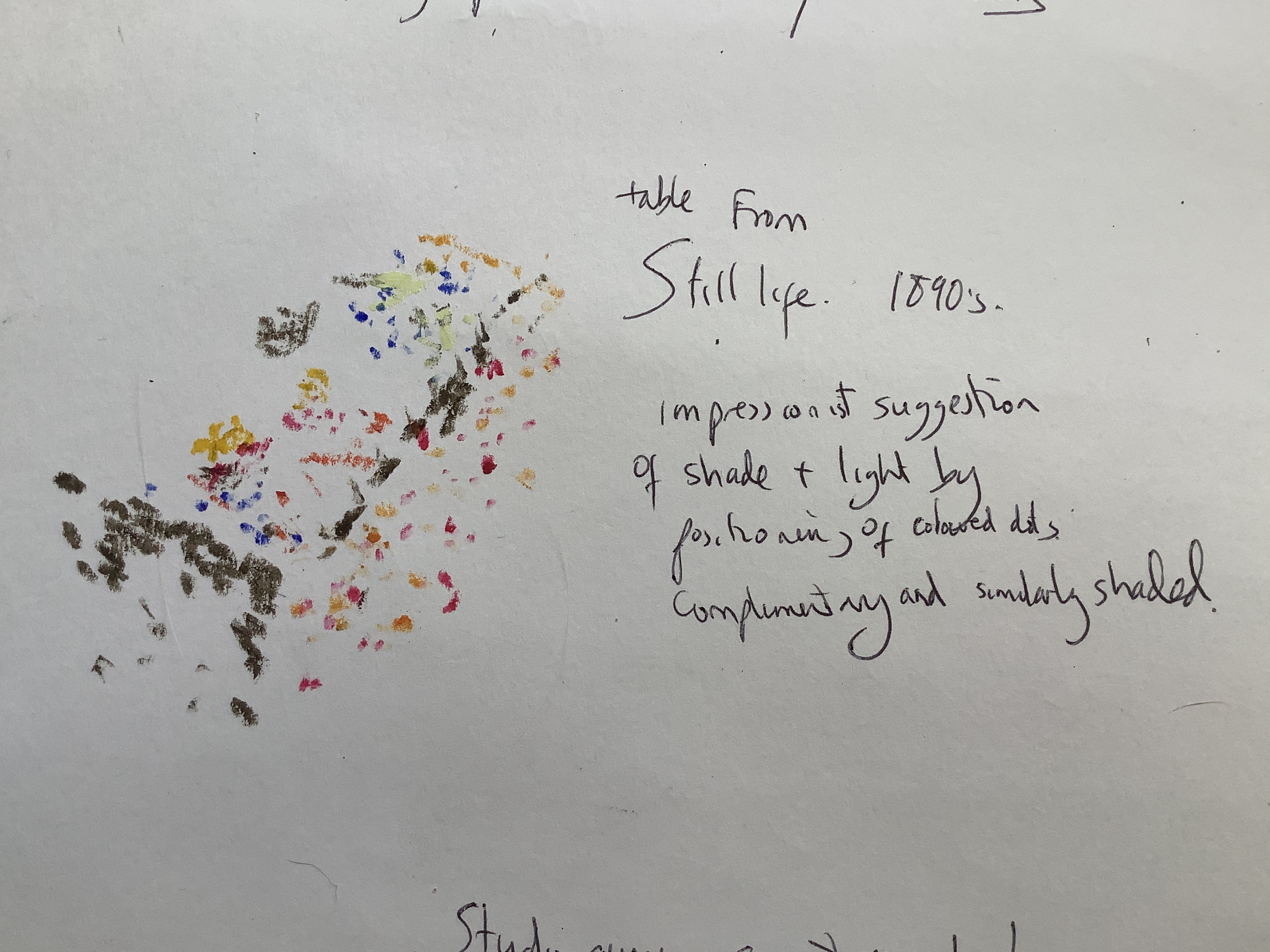
I would like to incorporate elements of how Picasso and Matisse use complimentary colour in small adjacent blocks ( eg Picasso weeping woman which I used to experiment with complimentary colour)
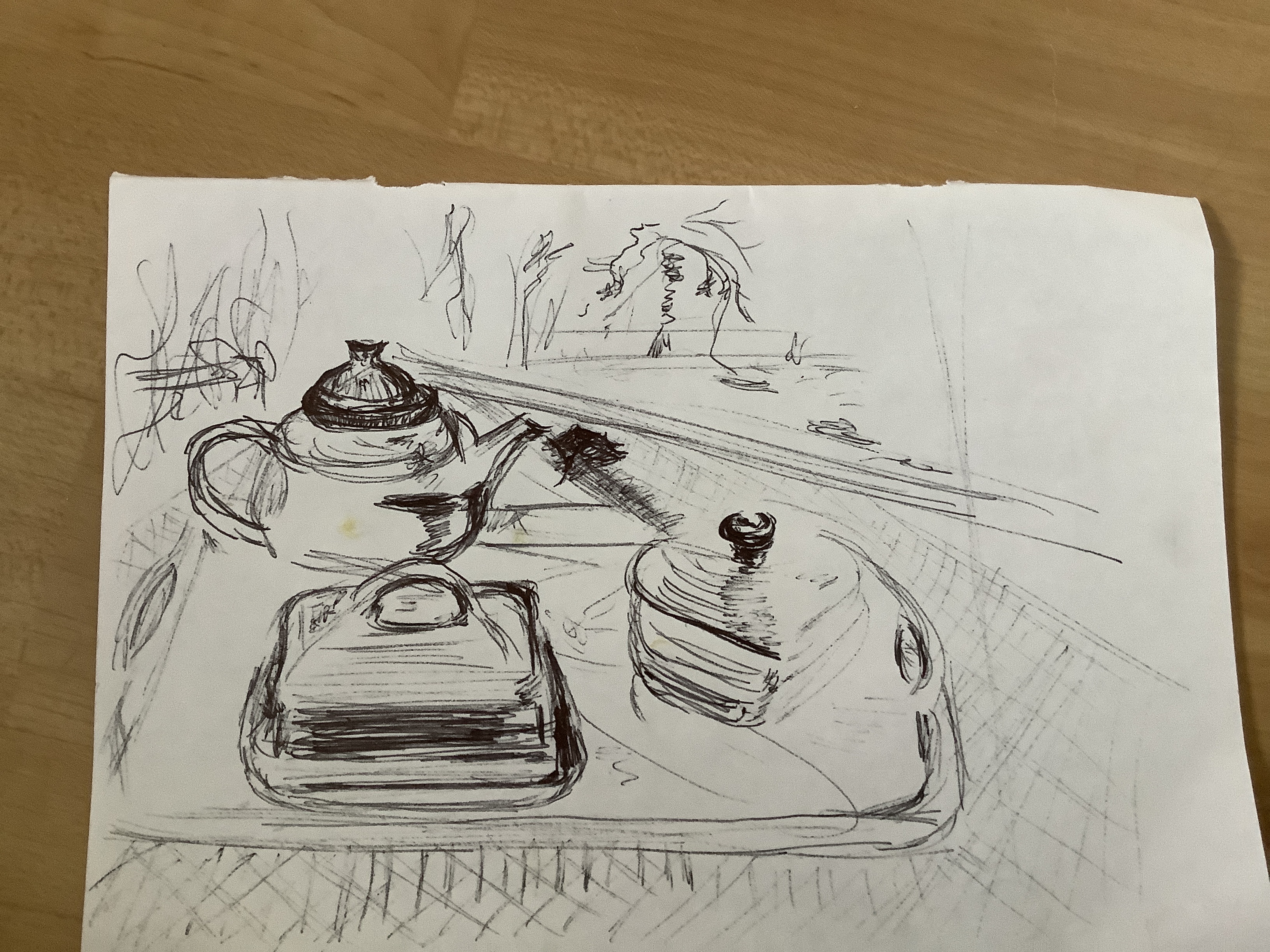
rough drawing of proposed scene, selected as the best through a view finder card to simplify the picture. I used a viewing frame card to help me limit how many objects I put into the scene as I have a tendency to choose to many which will make the view too complex and therefore less effective.
simplicity through blocks of colour and a few objects that tell a story is my aim.
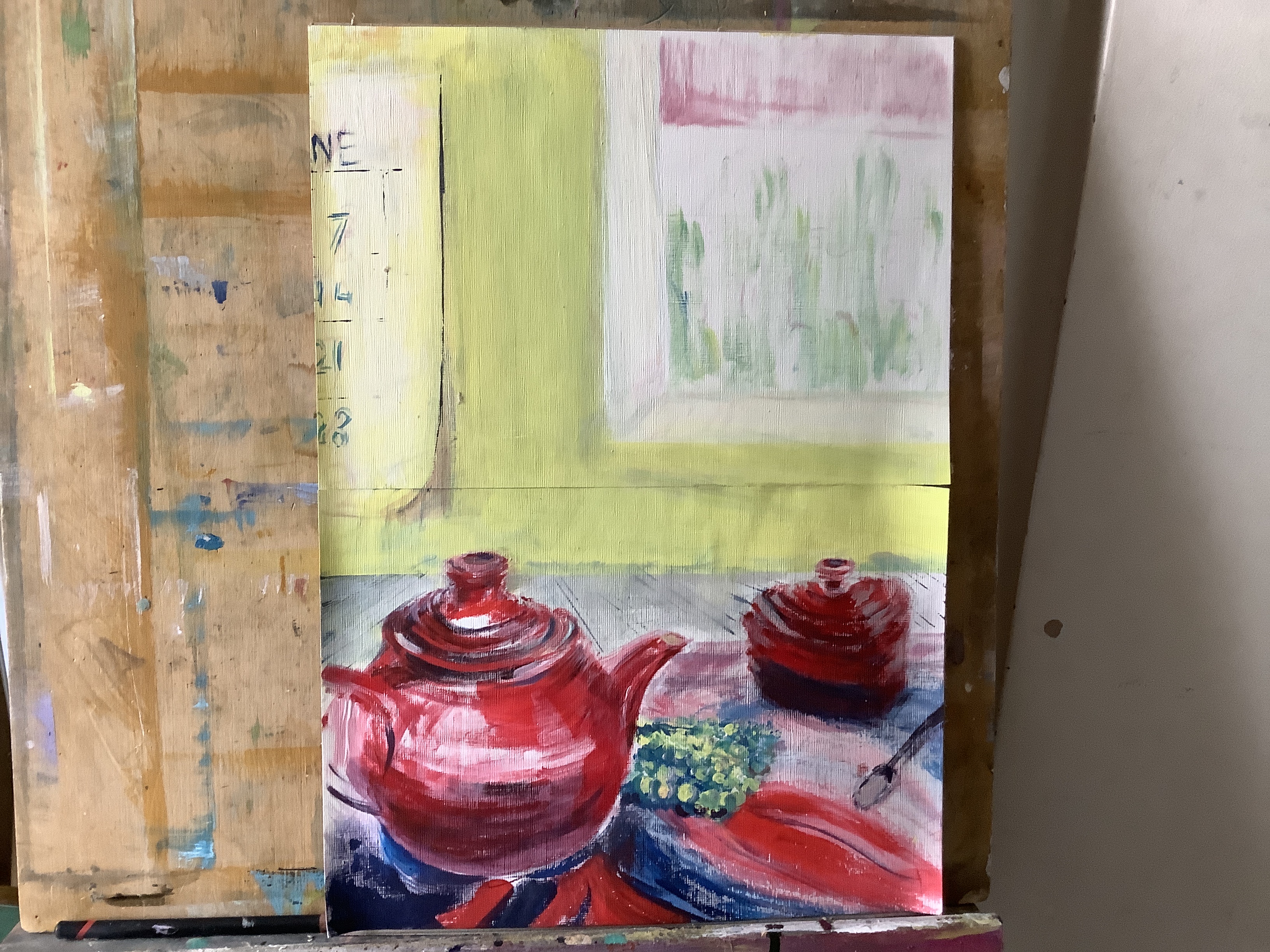
I like the arrangement of these three red pieces. The plan was to include greenery behind the garden tablet as a backdrop giving a complimentary block of colour for the red tea wear. I was also struck by the lines of light caught in rims in the pottery and thought this would be effective to show how light enhanced the scene.However on rereading the brief I found that it had to be an interior setting. I like the large areas of reflection produced by overhead light and want to keep this. Therefor I propose to use a small shaded window at the back of the table to give interest but far enough into a recess to suggest it would not complicate the scene with secondary side lighting. I then hope somehow to indicate that most of the light is from an interior overhead source. I am not sure how to achieve this other than by having a lampshade at the top which is not subtle? ( question to tutor please.)
Rough plan of perspective and colour blocks
While using a 1/2 inch decorating brush to make exploratory perspective marks , I noticed how much I liked the curve and sweep in the teapot and heart shaped sugar dish. Using this decorating brush allowed me to loosen my drawing and get a better idea of how I wanted the shapes to form in this assessment piece. Using this type of brush is a new technique for me and definitely one that I will use again. It also helps me to play with different angles of view and how these affect the sweeps and curves seen to create the composition that best suited my purpose.
I want to show how the strong overhead light falls on my objects reflecting their shapes and curves and opted to view the scene in a seated position which would allow me to show the pattern and tone on the side of the teapot.
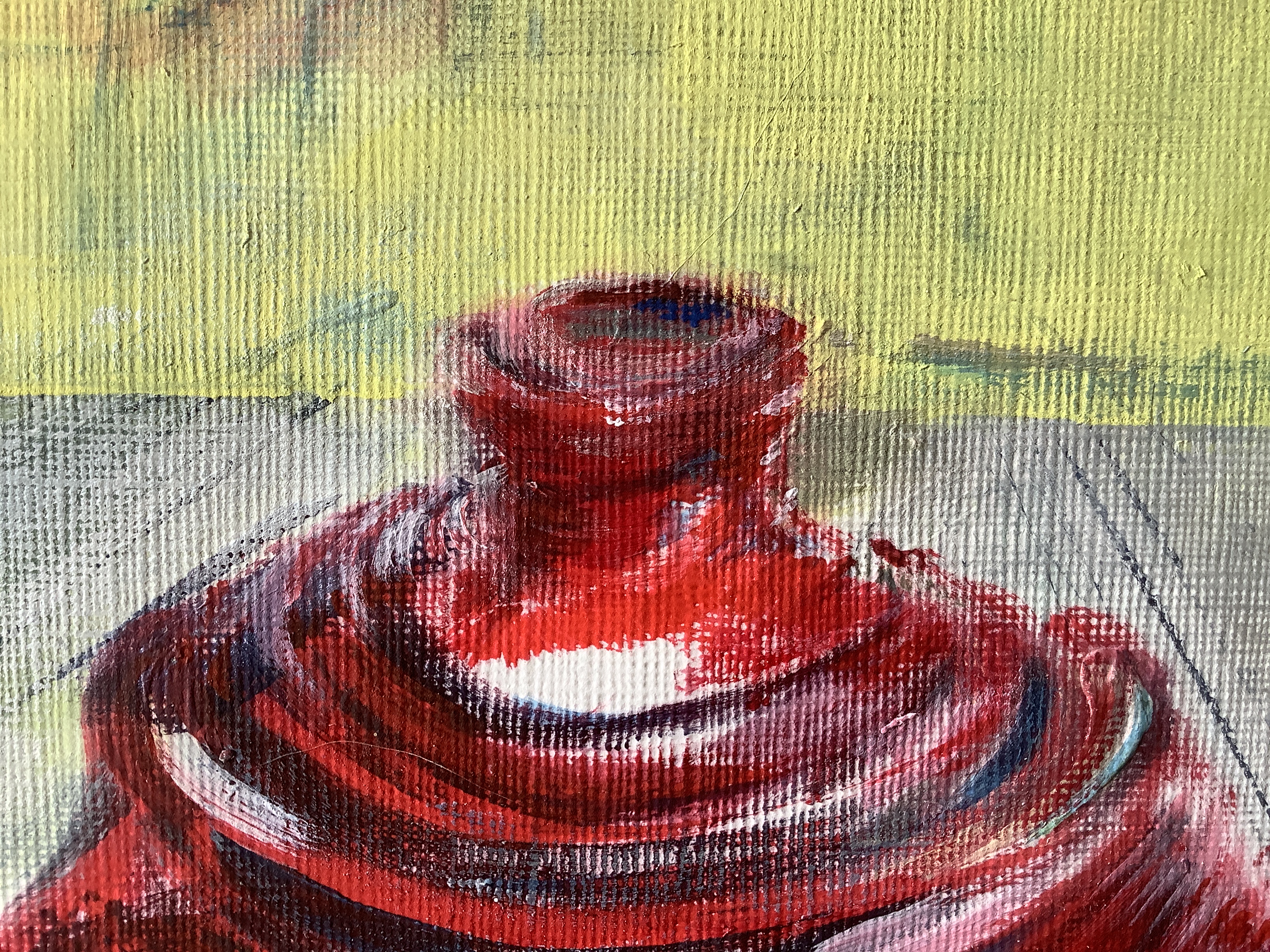
I found that I had several hues of a ‘primary’ red acrylic that helped me to show tone without flattening the colour by adding too much white or water. I realise that this does not conform to how the unit has looked at tonal production, however in this case the strength of red in the hue seems important to maintain.To produce the darker shades on the lower part of the sugar dish I have used methods practiced in the unit producing tones by added varying quantities of blue.
Later I decide to practice this effect with a closeup of the sugar dish. This also allowed me to explore light falling on it and study different tones present in the red. I was also able to echo the curves by showing the pattern of a similarly coloured flower tray underneath the objects.
I want to introduce complimentary colours so made sure that the yellow centre of the flower is in view and matched this to a blue suggesting shaded areas. Note that this is an artistic choice to maximise colour theory and blue was not actually present in the tray.
I used a rich heavy body red for the darker areas in partial shade and combined it in some areas with ‘phthalo. Blue ‘ liquid acrylic and an intense ‘primary liquid red’ for the full bodied areas of colour.
The main lines were drawn with a medium filbet and the sweeping pattern below the dish with a fish tale brush using long single sweeps.
Experiment above is with wet in wet as background for the table lattice pattern. I liked the softened pattern but decided that it didn’t really work with the strength of hue and curves that I wanted to concentrate on in the objects in my work. Next I tried using the edge of my paint knife with varying pressure and amount of paint. I liked the fading out effect that this gave and decided that I could use this as a tablecloth to suggest merging perspective lines at the back of the table (demonstrating a very simple element of optical mixing).
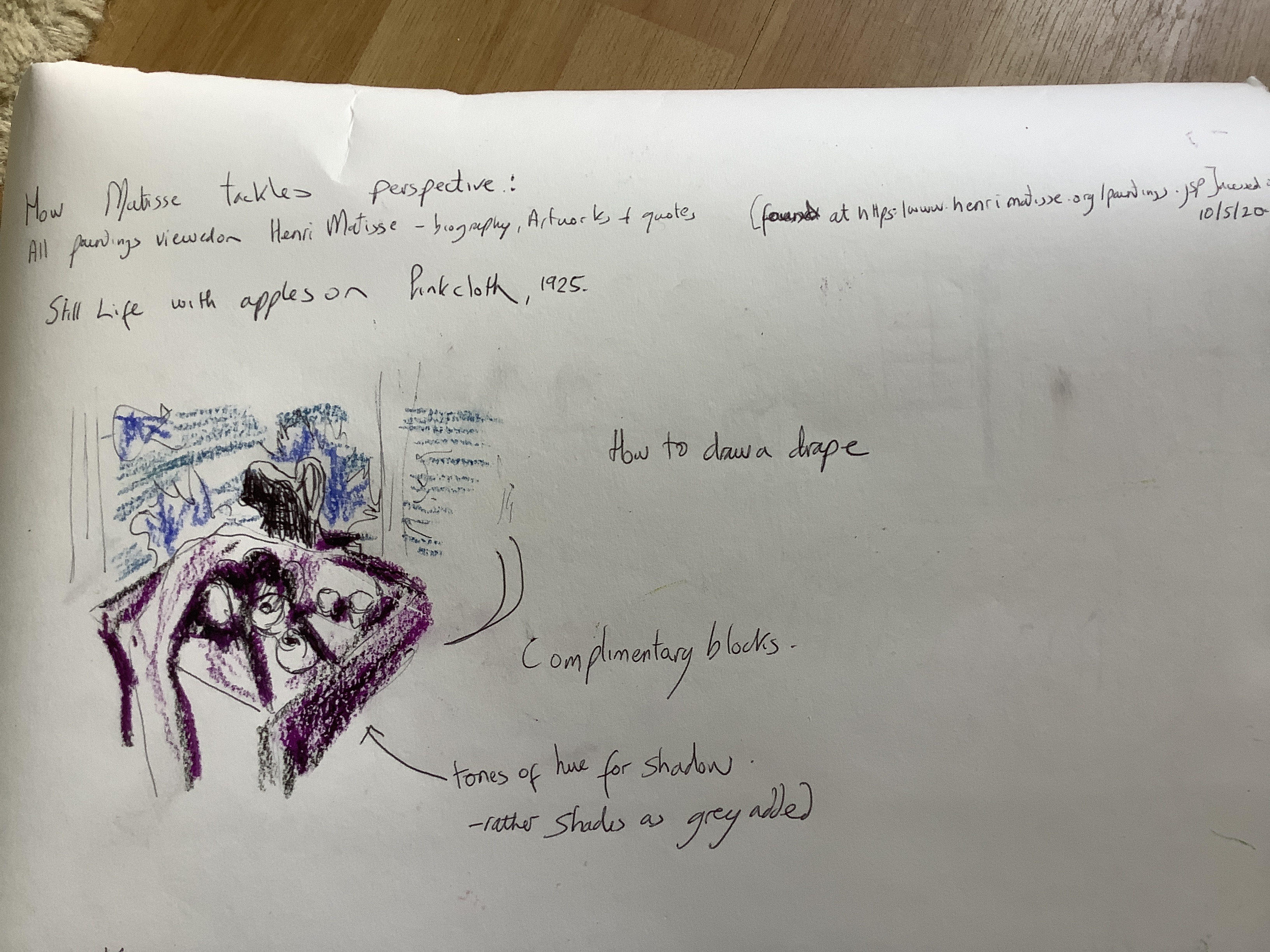
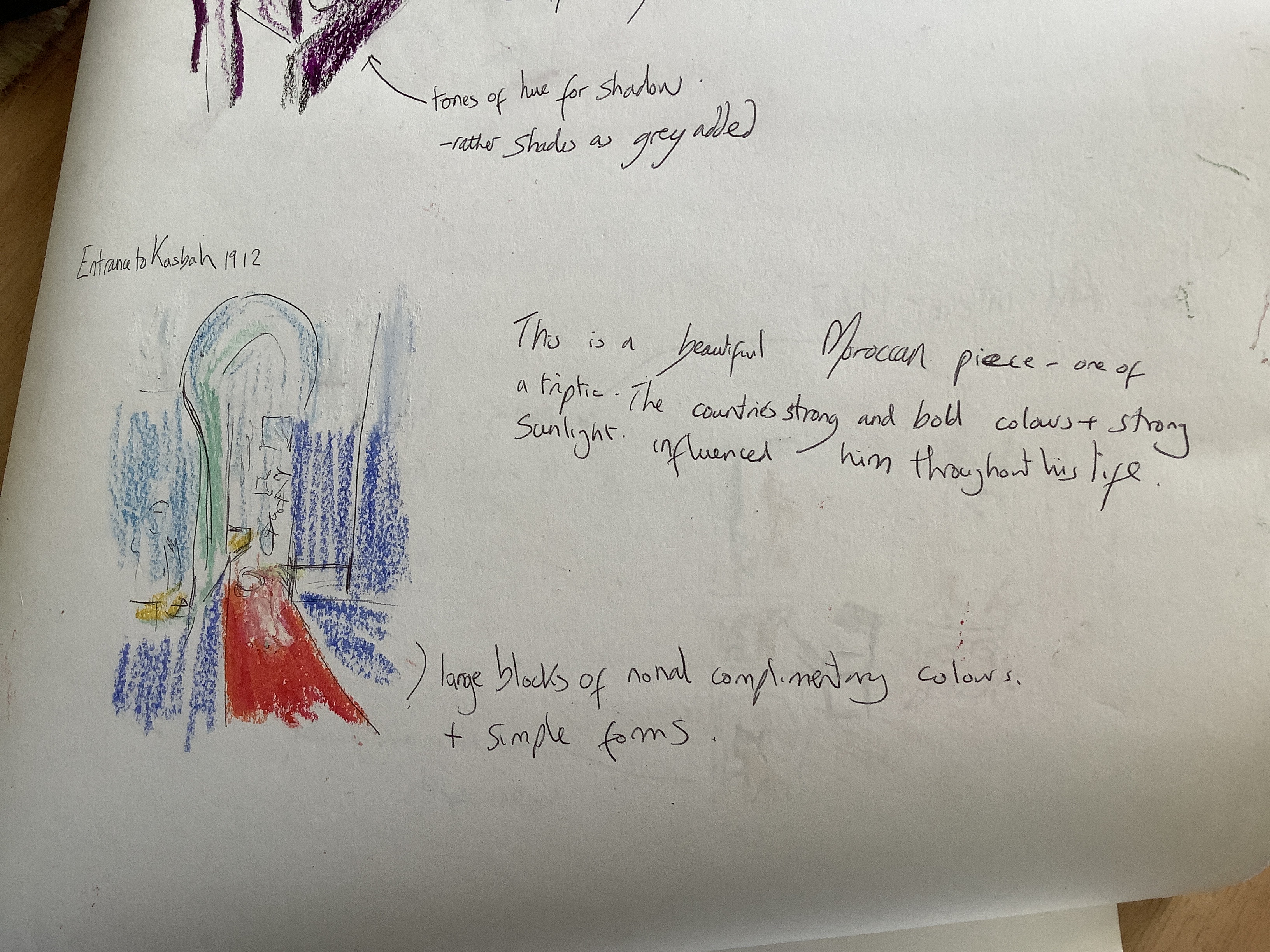
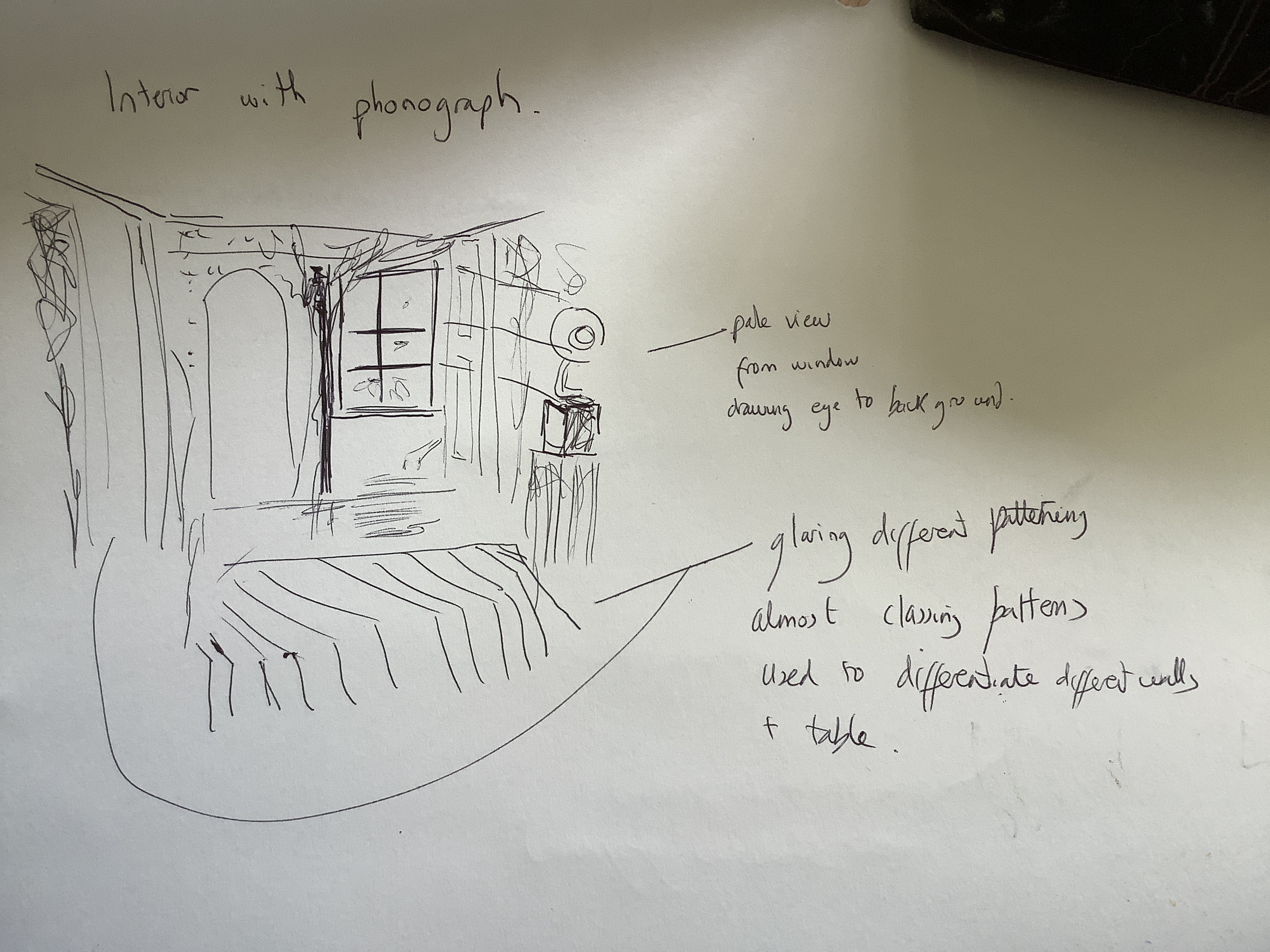
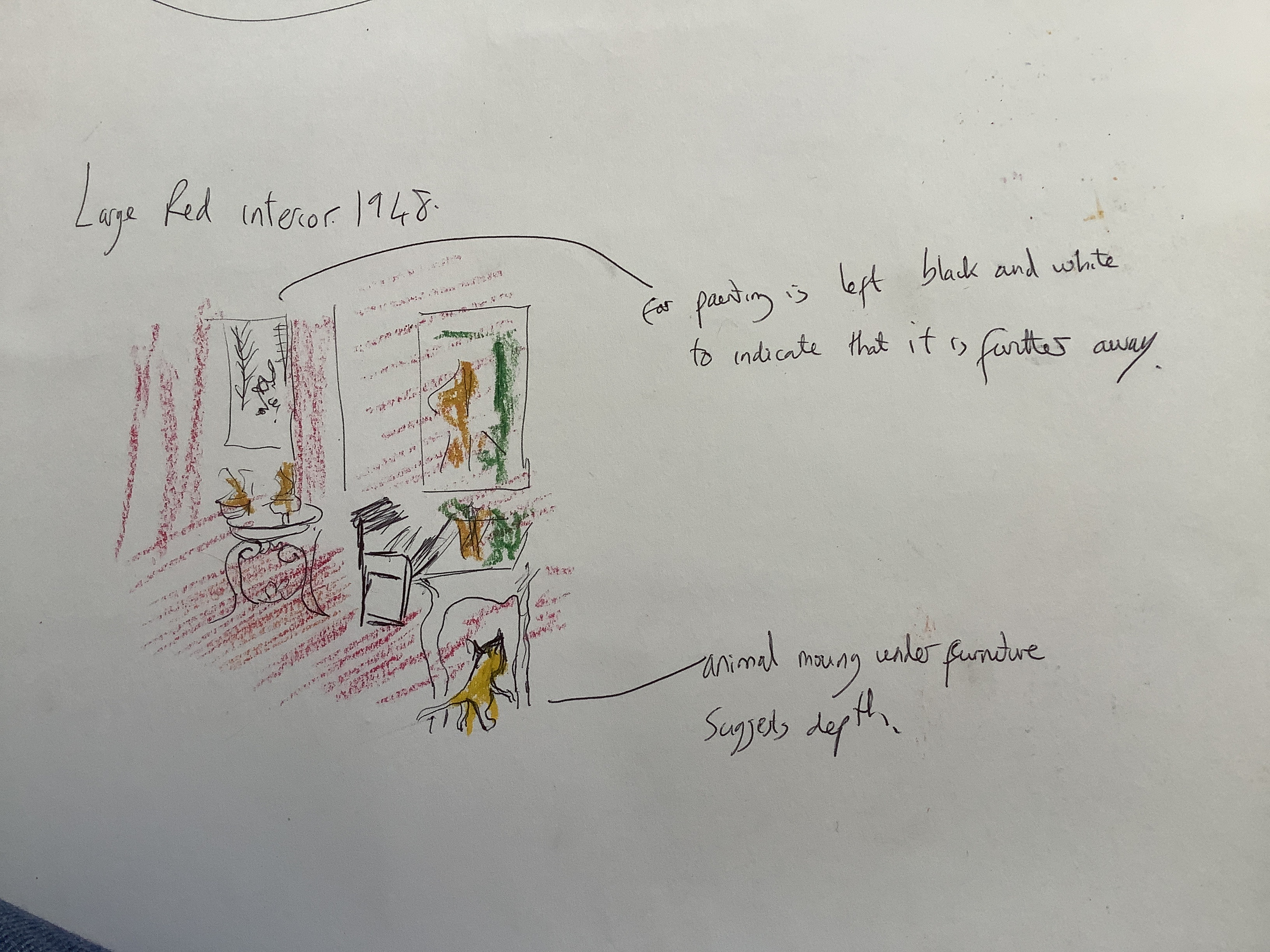
Looking back at my objectives, I wanted to examine how an artist using modern techniques would tackle the tricky topics of perspective:
I chose to look at the work of Matisse as he uses free style and bright colour rather than photo realism which I like.
The Matisse techniques that I can take on in my piece and assessment of points that worked and did not work in my painting.
1. Strong bold patterning to indicate different surfaces eg the table top tray and tablecloth.
2. the use of optical mixing theory with the diagonal line pattern of the table cloth retreating into the wall worked fairly well and I was please by the true straight line produced by using a ruler dipped in paint. I was able to show some distance by ensuring that the paint began to run out on the further away lines. In a further attempt I would practice this technique using more accurate techniques like a perspective viewing guide to get a more accurate vanishing point. This is a big step forward for me as I am typically quite impulsive and find measuring is something that I rarely do!
3. large blocks of colour in complementary hues eg red teapot and sugar which guide the eye through the painting to the window above which has greenery behind it works fairly well. Sadly the window and calendar are a bit contrived as I had to change from my planned far ground content.
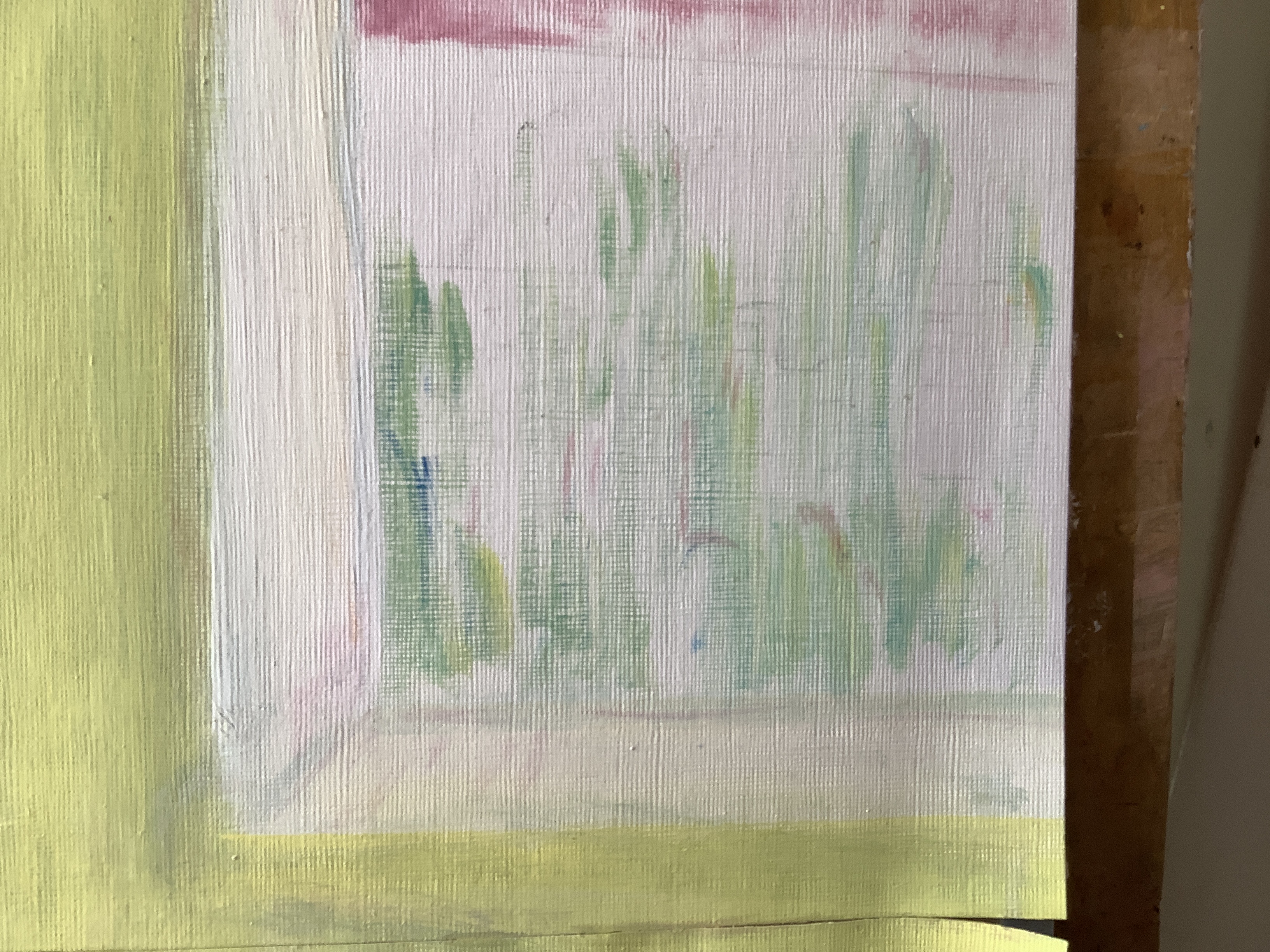
4. lighter colouring in the far distance eg the receding window where I have tried to suggest a wide sill Going back into the distance by using grey in the cream colour at varying strengths to make lighter shades going towards the window pane. Also the greenery outside is a block of complimentary green but I have made this a much lighter tone of green as simplified the greenery pattern into vague shapes to indicate distance.
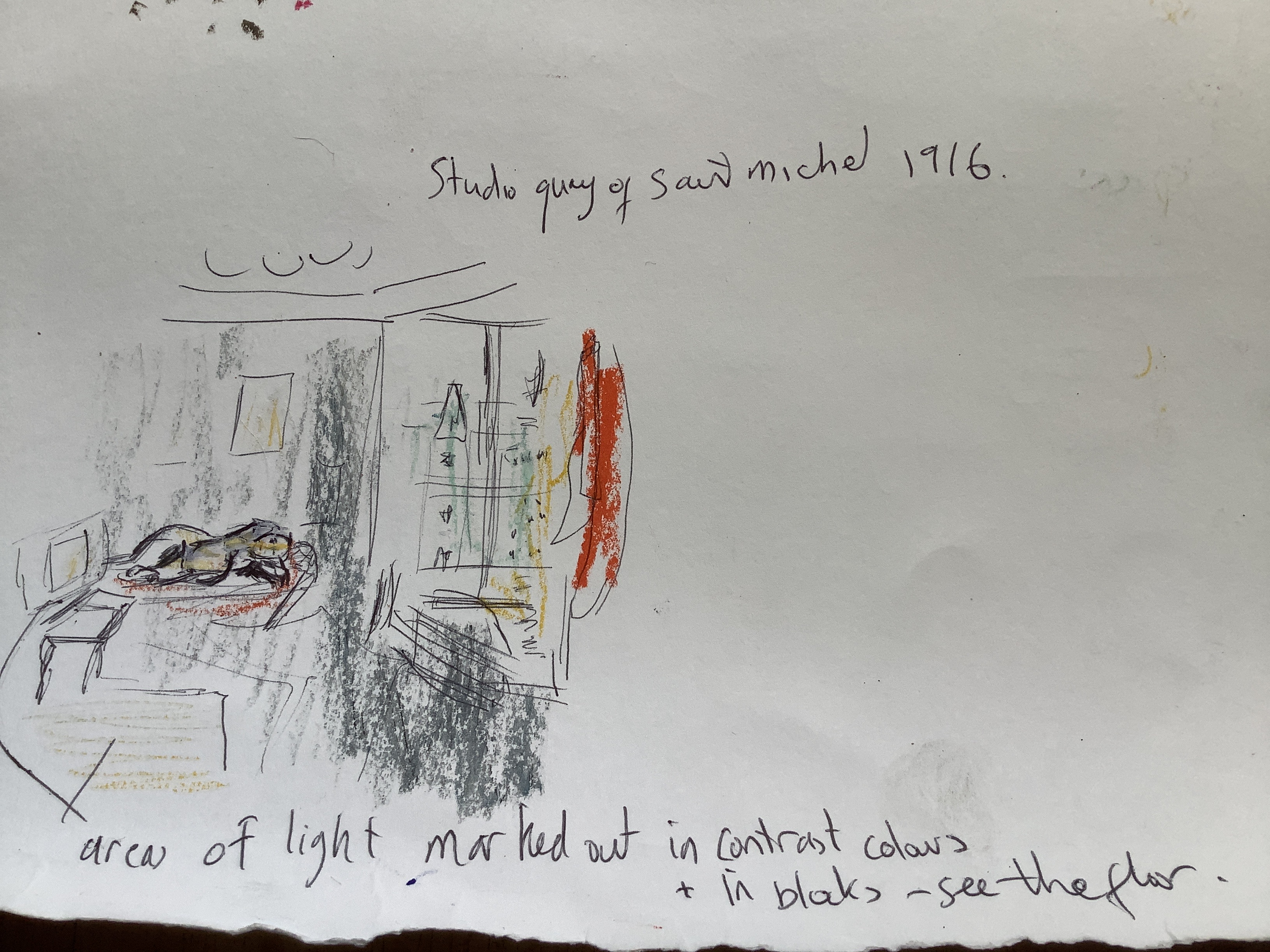
5. I ran into problems with the credibility of light from above ( see my reasons for trying to do this above in italics) . It didn’t feel as if it worked as how is the viewer to know that the light is above if the window is the only visual clue of light suggesting to the mind that light comes into the painting from the back. Therefore I tried to use a diagonal of light coming in from the window as Matisse did in the studio painting referred to in my notes. Sadly this came out looking wrong so I painted over it again. So far I have not come up with a good solution.
other learned techniques to suggest depth:
1. I have tried to emphasise areas of negative space to show distance. Eg the empty space behind the teapot nob at the narrowest part which attaches to the lid. Instead of putting definite division lines to show the red border of teapot I have kept this broken in shaded red and white light. The definition is made by an area of shadow behind it.
2. Colour theory suggests that light and dark allow both colours to look stronger eg. the hues of red – a light pink designating the back of the tray meeting the red of the sugar dish. The bottom of the sugar dish was a dark red due to shadow but I deliberately lightened the tray red with white and darkened the dish with blue. I believe that where they sit next to each other this suggests the narrative of distance.
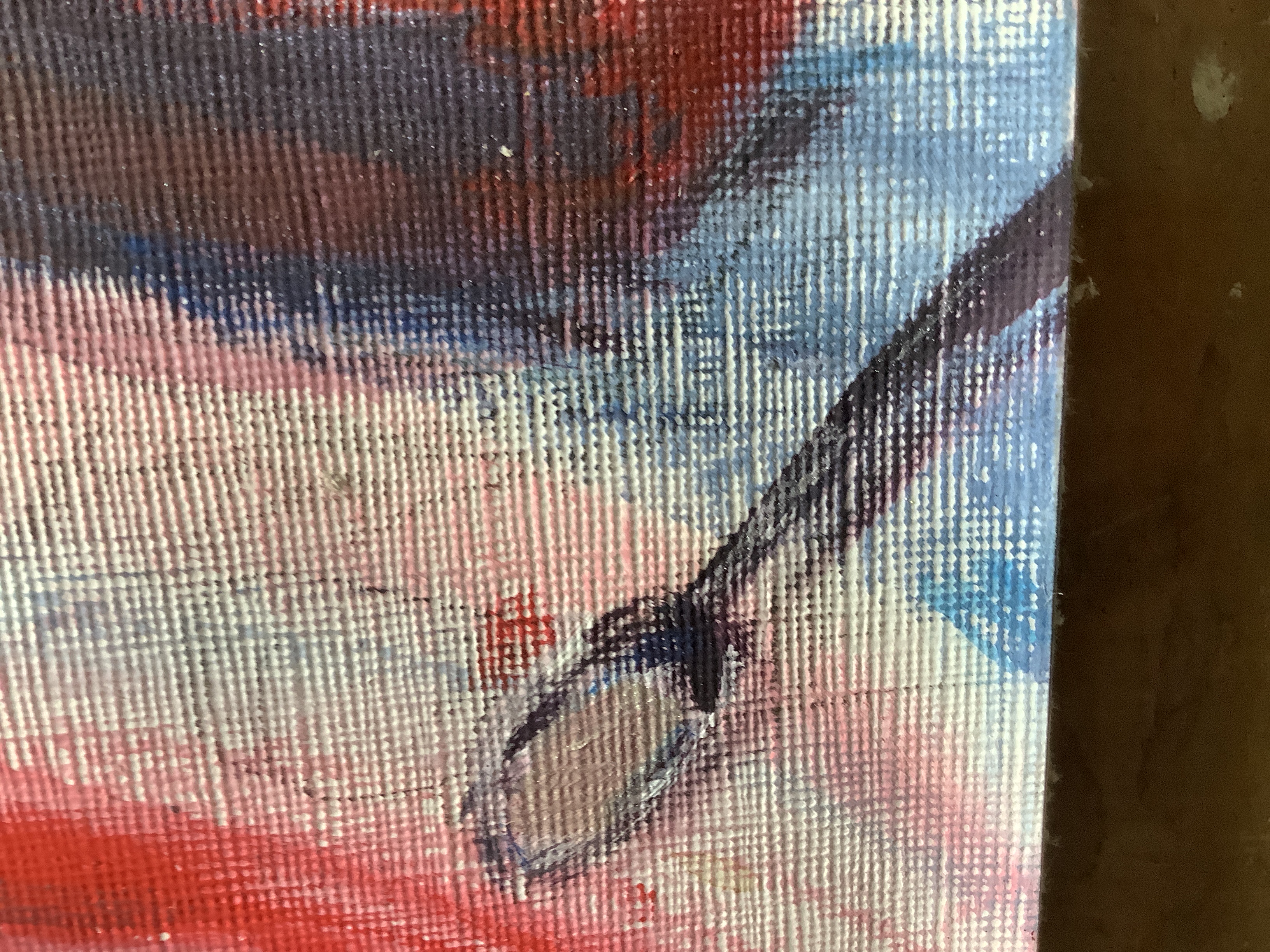
Also with the spoon. I lightened the opaque silver in the curves where light is reflected and deliberately made the shadowed darker to Payne’s grey parts of the edge and handle of the spoon and its shadow to emphasise that the spoon was not flat.
3. I used long sweeps while painting the teapot curve and the sweeping forms of the tray flower . I intended this to suggest movement in the work and feel that this has worked fairly well.
4. the movement and addition of a calendar on the wall are meant to suggest a time narrative to suggests my emotion and artistic commitment to the piece.
other errors:
1. Due to the time of painting taking place during lockdown I could not get supplies of larger paper than A3. I had to use two of these sheets and glue together on a card backing. I am not happy that some of my paper fixative spray has not stuck down well and the paper line is very visible.
2. While I have achieved some degree of depth which shows best in the tray, the teapot and sugar dish really would benefit from more layers of red tone. I tried to introduce this but felt that I was using shorter strokes between established shading and it looked forced. I should have had more shades of red premixed to use during the initial painting.
3. The lid of the teapot looks lopsided. Standing back more often during painting would have allowed me to spot this and make better adjustments at the time of painting.
4. The yellow walls and calendar look rather distressed and perhaps grubby. This originated for two reasons: shading for contrast to the square of light that I later removed and then further darkening to the walls and calendar to suggest that light from the window was limited and must have come from above as the white was only on upper Surfaces of the teapot and dish.
5. I was fairly pleased with the rich hue of red in the teapot body- this is not quite as balanced as the blues and red in my watercolour on cardboard flower and vase. In future I want to work more on balancing complimentary blocks of colour throughout the painting. Maybe I should have chosen green for the painted wall.
Fit to assessment criteria:
. Development of technical and Visual Skills Materials, techniques, observational skills, visual awareness, design and compositional skills- I have tried to use techniques practised and learned in this unit . In particular I have chosen to use areas of complimentary colour and a range of red tones ( especially) to indicate my growing understanding of colour theory and perspective
.Quality of Outcome Content, application of knowledge, presentation of work in a coherent manner, with discernment. Conceptualisation of thoughts, communication of ideas.- I am learning to use a process of thinking, planning and exploring to inform my final piece. In this case I have used previous paintings , sketches and tonal and colour studies to gain understanding of the subject before I began to paint. I have found this a difficult but rewarding development as my natural response is to get started and make things up as I go. For me it was a clear statement of intent for me to use a small view finder before anything else to refine downwards the complexity of what I chose to paint. I also thought about what would convey my desired message- in this case how light played on large curved blocks of colour producing shading and tonal hues.
.Demonstration of Creativity Imagination, experimentation, invention, Development of a personal voice. Context– I have had to simplify what I chose to portray. My tutor helped me in Assessment 1 to look with fresh eyes about what I can portray as simply as possible without clutter and techniques that I have not yet had time to master. I am pleased that I have been able to focus on a simple and small group of objects. It could be argued that fitting your imagination to work within your skill set is an appropriate use of creativity? Wishing this simple idea I found that I had more time and confidence to experiment with different brush strokes and mark making. (The fishtail for the sweeping flower on the tray and the side of my paint knife to print a fading straight line pattern on the table cloth. This is a learning point from Assessment 1 that I have tried to take on.)
It is also interesting to note that in simplifying , it gave me confidence to experiment and I feel that the marks and tools that I have learned will become part of my evolving style.
.Reflection, research (evidenced in learning logs). Critical thinking (evidenced in critical review).
I have enjoyed researching how artists have used colour theory and perspective. I feel that it has allowed me to experiment with their ideas and begin to plan to try some of these ideas in my own work. For example, I have been particularly influenced by the bright complimentary colours that Matisse used in his work ( see my drawings above ) and this encouraged me to use bright red and yellow in my painting. Also Matisse worked in a free expressive style using a variety of techniques to bring perspective to his work- often showing table scenes such as in this assessment. I have always avoided table perspective as I find it challenging. Studying Matisse’s method’s has given me new confidence to try. I have tried to pick up on elements of optical mixing and tonal hues to develop my table top perspective. I recognise that I have a long way to go with this and need to have courage to loosen up and paint free and single long strokes to achieve Better shape and texture in my work. I also need to take time before starting to have a wider variety of tones pre mixed before I start. ( Looking back at my Assessment1 feedback I note that my tutor mentioned this so Sadly I find it is something that I had not fully appreciated and Ai hope that pre mixing will prompt me in the future.) Experienced artists can do this as they go along but I need the visual prompt to discipline me to use a larger variety – in this case especially of my reds. I have tried throughout my commentary to look objectively at my work and assess what and how I can improve. I now also realise that having a mirror to look in or disciplining myself to step away from the painting much more frequently would help me greatly to influence what needs to be changed and do more of what is working well- before the paint dries and it is much harder to correct.
supporting work:
To illustrate colour theory: contrast in hue and tone
colour study- exploring blocks of colour and how light affects them
study exploring shape and tone affecting perspective